Blogs I love to read:

Saturday, October 24, 2015

Fourth rule - I am responsible for what I learn.

"The teachings of one's instructors are only to provide a minimum of assistance; applying these through one's own training is the only means of making these teachings one's own."  From the 1997 issue of "The Aikido" by Aikido world headquarters in Tokyo.  Volume 34, #4.  (Really, from the walls of the men's change room at our dojo.)

"The instructor can only impart a small portion of the teaching; only through ceaseless training can you obtain the necessary experience allowing you to bring these mysteries alive.  Hence, do not chase after many techniques; one by one, make each technique your own."  Budo
 
"The instructor can only impart a small potion of the teaching. Only through ceaseless training can you obtain the necessary experience to bring these mysteries alive." Best Aikido: The Fundamentals
 
"The teachings of your instructor constitute only a small fraction of what you will learn.  Your mastery of each movement will depend almost entirely on individual, earnest practice."  Aikido
 
Kisshomaru Ueshiba expounds on this in Aikido:

"The fourth rule relates to the assimilation of techniques.  Aikido has a few thousand variations in its techniques.  Some students are apt to chase after an accumulation of quantity rather than quality.  However when they look back on themselves, they are sorry to learn that they have gained nothing.  Soon they lose interest.  As innumerable variations of each technique are possible we instructors always emphasize the significance of "repetition" to beginners.  When you practice each basic technique, over and over again, you master it and then are able to use the variations.
 
"When the Founder first came to Tokyo, among his earnest students was Admiral Takeshita.  He wrote down all the techniques that he had learned under the Founder.  They amounted to more than two thousand, and yet there were more.  He was deadlocked, finding that he could do none of them well.  After careful consideration over several days, he understood the Founder's advice, "you should study, using the seated exercises as your base."  He practiced it and then at last became able to manage the techniques so well that he could acquire others which he had not yet been taught by his instructor.  For an elderly man of sixty years, it is the same:  repetition of the basics is the secret of improvement, no matter how awkward or unskillful one may be."
 
The exposition is a little perplexing to me in parts.  Pieces of the bare text refer to me of the importance of personal effort and exploration, and that the instructor is not the source of all knowledge.  When discussing the rule, Kisshomaru Doshu focuses on telling the student to not try to acquire more and to constantly repeat the basics, to do what we were shown and not embellish.  He does write that the first rule for practice is obedience, and maybe this extends from that.  If I tell a student to explore, I expect to see a few different things happen on the mat.

The one part of the fourth rule I think gets a little abused.  As martial artists, we have minimal training on how to teach.  No one else can do the work for you, very true.  If I do my absolute best to imitate the sensei, I am a poor copy.  I am not able to absolutely perceive everything that is happening with my eyes, nor am I able to feel absolutely everything being done when I take ukemi.  I cannot read any minds, so there is a great deal happening mentally that I do not have access to.  Maybe the teacher can tell me what the principle beneath the surface movement is, but that's no guarantee that I understand what I am being told.  I need to learn to feel what Aikido is, and then constantly hunt for it.
 
know beginning teachers who would use this rule to divest themselves of responsibility.  If the student is confused, they just need to train harder and it's the student's fault.  Tell them, Just keep showing up.  Lessons and understanding get withheld because "that's not basic enough for you."  I was told once, "I had to figure that out for myself, so you should to."  I feel the student has the responsibility to train, teachers have the responsibility to teach.  My student's failure is my failure.  The best teachers can see how to guide you to your own potential, or they can give you ideas that will help you find your own way.  

The story of Admiral Takeshita was very inspirational to me.  (I've wondered at what made over 2000 techniques - did he write katatedori Shihonage, Shomenuchi Shihonage, and Yokomenuchi Shihonage as three different techniques?  Maybe count every single variation as a separate technique?). Get a sense of a good Shihonage, and every Shihonage starts to improve.  Get a good Kokyu Doza, and a million things become more possible.  There is a level of fundamental body movement and integration that is at the core of many basic techniques.  In Takeshita's story, I saw there was a short cut to learning an infinite number of responses - study the basics.  The spontaneous creation of technique could be possible through understanding the basic tools. (I tried to not think very hard on how Shioda, Tohei, and Tomiki all had very, very different basics from what was given to me.)

Kawahara Sensei told us at Shodan we should be self-correcting.  Not running off and doing whatever, but that we had learned enough to know what a bad Shihonage felt like, or that we knew when to switch to kaeshiwaza or henkawaza.  When something went wrong, we could examine our timing, our placement, our structure and balance.  We could move beyond, "This doesn't work!" or, "I can't do this!" and arrive at "How can I do this better?" With this understanding, it's a short leap to improving techniques I think I already do well.  
 
I believe with a good understanding, I can also dissect a basic technique and see the possibilities within.  Yokomenuchi Shihonage contains a dozen other techniques like udekimenage and kokyunage.  
 
Good understanding of a basic also means that I can extrapolate - a basic idea can be slightly modified, or done in reverse, or used in combination with other movements to make something more advanced.  Yokomenuchi Shihonage is Yokomenuchi Koshinage.  I can see how movements relate.  Empty hand or weapon do become the same.  Kansetsu, Koshinage, Osae and Nagewaza are the same movement.  Musashi tells us one to one duels and battles with 10000 a side are the same.  I can't avoid acquiring more when I look at the basics.
 
So how did Shioda, Tomiki, Saito, Tohei and so many others ended up so thoroughly different from each other?  Different body types, different times and needs, different thoughts on what was important?  For beginning students in these systems, there are very few basics in common.

How do we as students know when to follow, and when to explore?  How do we as teachers know when to back off and let a student know they can head off on their own?  How do we tell when a student is - or more importantly, isn't - ready to drift off on their own?  What criteria are we applying, and can we communicate it?  

Friday, October 9, 2015

The One that Extends to the Infinite

This is a second piece of random thoughts about the Rules for Practice.  This one rule is by far the most concrete.

"Aikido is based on the Way of One which extends to the Infinite - practice should always be performed not only concentrating on one's front, but while keeping aware of all sides at all times."  From the 1997 issue of "The Aikido" by Aikido world headquarters in Tokyo.  Volume 34, #4.  (Really, from the walls of the men's change room at our dojo.)

 
"Aikido is an art where one person learns to face many opponents simultaneously.  It therefore requires that you polish and perfect your execution of each movement so that you can take on not only the one directly before you but also those approaching from every direction."  Aikido
 
"Bujutsu is an art in which the one is used to strike the many.  Therefore, train yourself to always be mindful of, and alert to, opponents in the four and the eight directions."  Budo
 
"Aikido is an art in which "the one" is used to strike "the many." Train yourself to be mindful of attacks coming from four and eight directions. Best Aikido: The Fundamentals
 
While these rules are attributed to O Sensei, the English translation is not.  Kisshomaru Ueshiba is the author of the first two sources above, and the fourth source is from 2002 so even the second Doshu had passed by this time.  In Aikido, the Doshu does offer some further interpretation.  "Budo is for countering any attack from any direction at any time.  When you are merely ready for only one opponent, without being prepared for others, it will only be a common fight.  A tight, on-guard posture with an immovable spirit is the basis of every exercise in Budo.  People generally say, "that man behaves irreproachably," or "An excellent artist is completely on guard."  Those who study Aikido should thus spend their daily life thoroughly on guard, even if they are not consciously watching every direction around them."  
 
The four different sources may appear very different because of the translator and the times.  The One that extends to the Infinite sounds maybe like a basic idea with infinite applicability.  The Doshu referring to being "irreproachable" sounds like etiquette, social mores, and a desire to never give offense.  Irreproachable is a word usually reserved for people of high morale character, but maybe a better word for this case is unassailable.  If I never leave an opening for an attack, or to cause offense, then I already have the upper hand.

The four translations do agree on one point.  We keep awareness of our surroundings.  We are always aware of the other attacker. The most recent translation does talk about the Four and the Eight Directions, and I am not clear what is specifically being referred to. I do practice some exercises I have come to call the four corners. I encourage students to learn lifting up and down on each corner - does that make 8? I see Judo exercises with eight lines drawn on the ground, and this is all before paying attention to Jodan, Chudan, and Gedan. I have heard of 36 directions, and no amount of quasi-mathematical torture of concepts has me defining this. The idea of multiple directions makes sense anyway.

Omote and Ura are about our relationship to our partner, and our environment.  I stand in left hamni and Uke attacks Shomenuchi.  I respond with Ikkyo Omote.  Uke now shields me to the right side, and I can move to my left.  If I respond with Ikkyo Ura, Uke now shields my left side and I can move to the right.

I stand in left hamni and Uke attacks with katatedori.  I respond with Shihonage Omote.  Uke is turned, but falls in the direction he was originally traveling.  He shields my left side, and I can run to the right.  If I respond with Shihonage Ura, Uke falls back the direction that he came from.  He now shields my right side, and I am free to move to my left.

It's a nice little mental exercise and a bit of variety, but the point really hits home when I think about where the exit is to the room, where is the weapons rack, where is the second attacker.  If I have a wall to my right side, I cannot move to the right and I cannot move my Uke to the right for any significant distance but I can make Uke have a forceful impact to my right.  The whole environment, including Uke, is my shield and my weapon.

I see this needing a different level of awareness, both of the environment and of the practice.  What we really don't need are different techniques.  The same basic movements let me travel in the environment, turn to face or move in other directions, throw Uke in whatever direction is useful.  

When a student talking about practicing some more combat effective stuff, invariably I see them take an MMA or boxers pose and develop tunnel vision on one partner.  Nothing wrong with these other arts, but if you've only trained in aikido your boxing will probably suck.  From there, take a Kotegaeshi and finish with jujigatame.  Drop to the ground from standing, losing many striking options and mobility. 


Our usual pins leave us safer and more able to respond to someone else - they're just not as forgiving to apply.  Pinning with one hand is not for style points so much as for making use of a tool or for manipulating an incoming attack.  I'm not saying Judo's (and many other arts) Ne waza isn't great stuff, and fun to practice, and high level.  


                                          The guy on the bottom is winning.


The little Judo I did, I had great success with this pin.  Against a second attacker - with my face on the ground and my testicles and femoral arteries raised up and exposed, I'm in trouble.


The next six pictures are all locks that straighten and hyperextend the elbow joint.

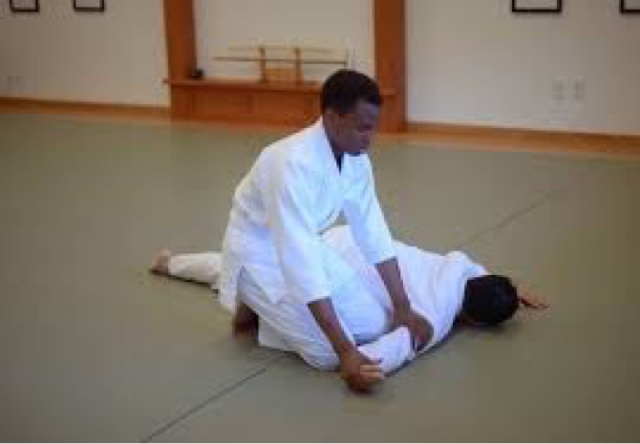
This pin has Nage's leg pinned, his other leg engaged to lock the elbow, and both hands on the other arm.  It's a great lock.  Nage cannot disengage quickly, cannot defend against another attacker, can't punch or kick without letting up on the pin.


This lock attacks the same joint and controls Uke in much the same way.  If Uke was holding a knife, sword, or club the pin wouldn't change much if at all.  The surface doesn't matter for Nage.  Disengaging can happen instantly.  Nage is gently kneeling beside Uke, but the knee could be dropped on Uke easily.  Strikes are possible, seeing the whole room is possible.  Versions on this pin are used to handcuff an assailant.

This is the same elbow lock again

And again.  Hamni Handachi and Suwari Waza are practice in fighting from this pinning posture.

And again.  This time, Nage has all four limbs tied up attacking one of Uke's limbs.  The influence of MMA in the martial arts world today has made this pin much more prominent.  I feel Nage is more vulnerable with a second attacker.

This is another version of the same pin, and this time Nage is face down with one leg pinned underneath Uke.

I love practicing all of this stuff, and it is important to know.  But, as dojos are coming into competition with MMA and BJJ, we're letting other businesses define what combat even looks like.  Then, we apologize, and we say we are less combat oriented than the local strip mall.  Where they train for the Octagon - one on one, no weapons, in a controlled environment on a safe surface with a referee.  The skill sets are so different that they need not be mutually exclusive.

When I talked with a friend recently who has an Aikido dojo close to a large military base, he was clear about what the soldiers he taught told him:  going to the ground in a war zone with sharp shrapnel, explosive devices, unpredictable terrain, knives, and guns is unthinkable to a soldier in Afganistan.  I've heard the same thing from a contractor in Iraq.  They want to be mobile, free to use weapons, free to disengage, free to take and provide cover, free to work as a unit.  They don't approach one attacker as a one on one confrontation, even when they don't see a second attacker.  Everyone is also a potential suicide bomber.  I'm not military, but I spent time working in corrections.  I wouldn't lay on my face to pin one person in that environment.

When other arts like Baguazhang say they are for multiple attacker situations, this defines what techniques are Baguazhang - always in control of the relationship to their environment, rarely going to the ground, rarely getting entangled.  

I find it interesting that apparently modern soldiers don't argue much with tactical recommendations from military trainers like O Sensei and Tomiki sensei.  (Aside from the part where "fighting" means helicopters and firearms). Saito Sensei had exercises for fighting a larger group, and Shirata Sensei had a series of exercises based on Shihonage against two swordsmen.

The questions now come from ourselves.  I think we break this guideline a little too much.  We don't train a committed two on one attack.  The best randori I ever saw was done by a basketball coach who played a great 2 on 1 game.  It was rare to see.  

On my Sandan test, the examiners ordered my attackers to come one at a time and avoid any collisions in a huge open mat with all yudansha attackers with great ukemi.  Five attackers coming in quick succession is not as hard as two coming at the same time, particularly if the two are trained to work as a team.  It's hollow to claim we're more useful in this regard than other martial arts when we've never actually trained this ability.  This awareness of the environment and the ability to manipulate it to advantage is maybe the most self defense oriented skill of all.


Sunday, August 30, 2015

Green Papaya Salad

I first came across this dish in at a Vietnamese restaurant in Calgary. It was briefly available in one restaurant in Durham that sadly closed down.  Every time my wife and I go to Atlanta, we go to Com which has a fantastic version of this.  I'll buy extra to take home for breakfast.  This is my primary Atlanta Aikido seminar food.

Green papaya is not actually a different papaya, it is a papaya that is not ripe yet.  The flesh is firm, almost crunchy, and a faint greenish white.  Many stores in Durham don't sell them.  I have heard nasty rumors that some stores won't put them out until they've turned orange and much softer.  There is one large Asian market that has helped me out on several occasions.

I once had a version of this in Saskatoon with sliced raw cabbage, and I think the green papaya is similar to jicama.  The Com version isn't pure papaya but also has green apple, shredded carrots, and rice noodles.  It's probably the same as trying to firmly define a salad in any culture - there are variations.  You can skip the papaya altogether (and I've even done it once with red papaya but the outcome isn't the same.)

If you can get a green papaya:

I take the skin off with a potato peeler.  The inside is full of white seeds and some threads which I don't know if they are edible; I just throw them out with the peels.

An ice cream scoop will take out the seeds and clean the inside out a bit.  I bought a tool to help with cutting this up.  A hand mandolin?

So I end up with a bunch of long slivers, which I usually see in restaurants.  If you can do a good julienne, good for you.  I used the shredder on my food processor before I got this, and I think the pieces need to be small.


This is about five cups of shredded papaya, so I add one peeled green apple and three small carrots shredded.  This is optional, and if I am eating alone I tend to just do the papaya.

Now the herbs.

Apparently what is sold as Thai Basil isn't the actual herb of choice in Asia for this dish.  It is still better to use than basil for Italian food.  It's also a more heat resistant, faster growing perennial that Japanese beetles do not eat (I use no pesticides, and this plant seems to have no predators in my garden).  I also think it is a prettier looking plant with white flowers, purple stalks and smaller leaves.  There is a licorice aftertaste that I love.


(Notice my regular basil looking yellow, sad, and dwarfed immediately to the right of the Thai Basil plant.)

About one cup of Thai Basil leaves for a whole papaya, chopped.
Mix this with about 1/3 to 1/2c of chopped mint leaves (the variety doesn't make a difference for me with the mint).
Then as my wife doesn't like peanuts, I use 1/2c of toasted and ground pistachios.  Other nuts are probably fine, but peanut is still my favorite.  Throw the peanuts and chopped herbs in, mix them around and put this aside as you make the dressing.  This can last covered in the fridge for a few days, so this is easy to make in advance and then add the dressing when you are ready to eat.


The dressing is mostly citrus juice. 

3tbsp of lemon
1tbsp of lime
(The person who gave me this recipe did four tbsp of lemon.  I have done four tbsp of lime and I love the mixture of the two.)
1 tbsp of fish sauce (smelly, but great)
2tbsp of sugar (you can do less, and you can substitute Stevia but use maybe only a 1/2tbsp.
A dash of ground pepper
1tsp chili garlic sauce (a cheat I have started doing, but I was originally told to use two garlic cloves and two Thai chilies).  My wife can't stand the heat, some people need more.  You can always add more if you're one of them.

Mix the lemon/lime, fish sauce, pepper(s), and garlic together.  If I am using solid garlic and chilies, I use a chopper or food processor again.  This mixture lasts well for a few days too.

Some meat!  My wife does not eat red meat, but beef is common.  Really, I have seen tofu, shrimp, scallop, salmon, beef, chicken, pork and any mixture of the above.  Often I see barbecued meat, and I love it but the originals I had used JERKY!  There are special Vietnamese jerky recipes out there, but I swear the one place just had cut up a very basic teriyaki beef stick like I could find in the gas station.  365 Brand has a very nice teriyaki flavored jerky, and we eat the teriyaki turkey with this the most.  If I get a proper barbecue together for this, I'll post it but probably something Asian and heavy on the lemongrass.  If served with barbecued meat, the meat is usually served hot on top of the cold papaya, but the meat could be cut up cold for a nice hot summer meal.

Sliver the jerky, throw it on top (if you are using jerky, it can sit with the fruit.  If you are doing hot meat, keep it separate until you are ready to add the dressing and eat.

You can add rice vermicelli that has been cooked up and either hot or cold.  Because I want the papaya to shine, I do half as many noodles as papaya.  Maybe a cup of noodles to two cups of papaya, but I didn't use noodles on the day I took the pictures.  Add the noodles right before the dressing, especially if you are using hot.  If you are using noodles, you may need a little more dressing.

And, whenever you are ready to eat:

Add the dressing and mix all the ingredients well and you have a party in your mouth!  Throw some more chopped nuts on top to garnish.

This is what I ate the night before, and the morning of my Sandan test.  I love it!  I was having some difficulties finding a simple recipe for this, so here y'all go.  Some uncommon ingredients, but amazing flavor and healthy.


Sunday, August 23, 2015

Tanto Nage

In the 1950s book Aikido written by Kisshomaru Ueshiba, the second Doshu, he makes mention of three ways that Tanto-Waza is practiced in Aikido.  
1.  The Uke has the knife, and Nage is unarmed.
2.  The Nage has the knife and Uke is unarmed.
3.  Both Uke and Nage are armed.

I have only formally had instruction in the first.  I remember Kawahara Sensei sometimes doing Morote-Dori Kokyu-Ho while holding a Bokken, but Tachi Dori was the far more common practice and the one required for testing.  Only Jo work clearly followed the formula above, with Jo Dori and Jo Nage required for tests and Kumi Jo appearing in training.

There are a number of interesting ideas out there, like this clip of Chiba Sensei doing Shihonage with a Bokken.  I have heard that a large number of our wrist grabs can be applied to Iaido, and an old book by Bill Sosa showed the same movements done for handgun retention but presumably also for radio, baton, taser, handcuffs and other tools.  I've known law enforcement officers to say they appreciated the concept - they can go to the firing range, or they can train empty hand at any dojo but other tools are harder to train with.  Here is a clip that focuses on handgun retention.

This dojo in Mexico has a nice clip online of them doing Tanto Dori and Tanto Nage.  They are wearing hakama, so I assume they are not part of Tomiki lineage which has the most material on Tanto Nage retained in their system.  Shodokan Aikido's Koryu no Kata Roku is a very interesting weapons primer, with a Tanto being used by Nage at 1:25 to 2:00.  Google books also has Aikido the Tomiki Way online, and the same techniques are discussed in pages 278 to 281.  I have to concede that kata is an effective method of retaining knowledge and disseminating it.  Shodokan Aikido's Nariyama Shihan also has this clip of Tanto Kaeshiwaza, so the ideas can also be more broadly applied and expounded upon.

In the Looking Back to Look Forward vein, my wife and I study an Aikido system that often does not have Nage grab.  I found this to be a worthwhile tool for anxious students who desperately need to clutch something - give them something to clutch.  But, some people couldn't bring themselves to use a Tanto in this fashion - they just didn't have the killer instinct, or had the instinct too thoroughly.  Besides, we have the sharpened wooden ones on hand, not the foam competition ones Tomiki students use.

I started to bring a little stuffed teddy bear to class, then an old flip cell phone, then a small diary.  I had students explore basic techniques they had known for years holding items they would use as weapons, and items that they would want to protect.  My wife and I had a young woman looking for self defense classes, and we did similar things with a small backpack - using it as a shield, or protecting the contents.  I started to do demos holding tennis balls, or the ceiling fan remote control.  One young Muslim woman who could not touch a man due to her religion, she was giggling and having a great time throwing me while we both held a baton.  A two year old ran onto a crowded mat during a busy seminar to talk to her daddy, with bodies flying everywhere - I caught her, picked her up, and blocked a few people from reaching her before I got her off the mat.  As a nurse, I am often carrying medications or equipment that I don't want to damage nor do I want to throw something on the ground just to do Aikido.

I made the comment to some Duke students that if they were off on the running trails around campus their car keys are how they get to safety, or get back into their home.  Their cell phones are how they call 911 or their friends.  I imagine this is also how Aikido would make use of pepper spray or other non-lethal weapons.  On the other hand, if all they had was a rock or a stick against someone larger, I wanted them to know that they could do the same Aikido.  The hand that wasn't seizing anyone now had many other uses, and I think this developed some awareness of Atemi as well.

I am not sure why the Tanto practices in Aikikai have become so one-note.  This is a historically valid Aikido practice that offers some great insights and practical information for students of all levels.  

Of course, while training with this for months with a couple of students, I was going to shoot a clip - and I now have a partially torn Achilles, so no clip of me doing anything for a while.  But, give it a go.  Pick something soft, and I'll bet you already know everything you need to.

Sunday, August 9, 2015

Three forms of Iriminage

A few weeks back I started on a blog entry I've been meaning to do for a long time.  The first book on Aikido I ever purchased was by John Stevens and Shirata Rinjiro, Aikido: The Way of Harmony.  I doubt it is still in print, but I can't recommend everyone enough to get a copy or at least an e-book if there is one.  Shirata Rinjiro was a prewar student and a contemporary of Kenji Tomiki and Gozo Shioda.  The book contains meditation techniques, a variety of Tanninsu Gake (multiple people holding you), five classical Shihonage variations shown both empty hand and with the sword - lots of stuff, lots of rare stuff.

I never met him.  I've probably made mistakes in this blog entry, and they are mine alone.  I am certain if I understood these ideas better, each one would be an essay on their own.  I also doubt I demonstrated them well, and if there is a better video out there, I would dearly love to see it.  I know I did not show exactly what I saw in the stop motion photography images available to me.  Also, as this was unfamiliar to my Ukes, thank you Ross and Rob for putting up with my experiment.

As a beginner, I was learning Iriminage with a 180 degree turn, and I was seeing Steven Seagal on the big screen doing a single step linear form.  I was introduced to the 360 form eventually.  From the beginning, I was told if I was stuck to just keep turning.  

The USAF briefly had three Tsuki Iriminage on the test requirements; we interpreted this to be a linear Irimi, a tenkan, and a tenshin.  It was okay to do several openings with the identical final technique.  This is a valid insight - if you can neutralize an attack several ways and still get to the same technique, the technique is something you can access more readily.

Chokusen no Irimi is the linear form of Irimi.  Sometimes Shirata Sensei looked to be demonstrating a renamed Atemi waza, but the more prevalent version was getting deep behind Uke and continuing to move backward.  Nage does turn enough to see the room, but the direction of travel is pretty much on a line.  Uke's head ends up straight behind where he was standing no matter which version is used.  Kuzushi for Uke comes from either being broken directly backward or led in a paper clip.

En no Irimi is the circular version of Irimi.  Some of Shirata Sensei's distinguishing between triangular and circular entry wasn't always clear to me.  I never got to feel it, so I have my own reinterpretation, and I may be wrong.  Like a rock attached to a string being swung around in a circle, Uke's feet are moved outwards by momentum while I secure his head.  We circle until I stop and Uke wraps himself around me until he falls and I "let go of the string."  I understand Centriputal Force does not exist, but I am sure I used that term to describe this throw.  If Uke moves backward, I cause Kuzushi backward and to the nearest corner.  If I throw him moving forward, I cause Kuzushi to the front near corner.

Sankaku Irimi means triangular Irimi.  Uke is broken in one direction, then I use my body on another vector to displace his center.  (Honestly, reading this, anyone might think I did better in high school physics than I really did).  My wife loves this center displacing motion.  The timing is a little more finicky compared to the other two variations for me, as Uke keeps moving.  I need to end up cutting through Uke at a 45-90ish degree to the initial Kuzushi.

After posting a clip of Shirata Sensei doing Omote and Ura, I was a little chagrined to notice I demonstrated only Omote versions of Iriminage.  Maybe next time?

Yoshinkan has two versions of their Shomen Iriminage.  I was taught Shomen Uchi Shomen Iriminage (II) as a linear movement to break Uke's momentum and balance (not emphasized in the video) followed by a circular lead and an Atemi to change direction, then finishing with my hips bisecting Uke between his head and feet.  All three ideas in one form?  There is also a Shomen Uchi Shomen Iriminage (I) which does not have a turning component but very much starts linear with a Sankaku finish, so the ideas are not mutually exclusive again.

The Aikikai versions I was taught, they weren't given specific names that I caught, but different variations were required.  I like to use the framework of these three ideas to interpret what I might see the instructor doing.  The openings can change, then the application of the technique, and then the Kime.  It's not more simple - the three main openings, to these three ideas (each of which has two main variations (?), so maybe really six) to the two finishing forms (there are more) is now a minimum of 36 versions.  Except the ideas here can be mixed and matched, and kept in a variety of combinations and done to a wide variety of vectors.

I've not even touched on the Yoshinkan's Sokumen Iriminage (I) or Sokumen Iriminage (II).  I use this term as Sensei once told me, "No Iriminage!" when I did this version on a test when I was supposed to be doing Morote Dori Kokyu Ho (I brought my arm that wasn't being held across Uke's throat, and Sensei wanted me to use the arm being held to do the same throw).  I never heard him use this term otherwise.  Shirata Sensei does seem to use this idea as an Iriminage, and from the text I thought maybe also with circular, triangular, and linear as well.  I don't see how the same Omote and Ura ideas would apply, maybe they do and maybe they don't.

In the Art of Peace translated by John Stevens, O Sensei says acquiring the basic forms of Iriminage can take 10 years.  (I am on the slow path).  In the same book, O Sensei says the best strategy relies on an unlimited number of responses.  I feel that learning widely disparate variations brings me a little closer to the unlimited mindset.

We don't use these ideas in Aikikai as I learned it, but I found the ideas helpful.  One example for me of Looking Back to Look Forward.


Friday, July 31, 2015

The Power of Friendship

Aikido is a relatively young art, but has a huge broad base.  Morihei Ueshiba had many contemporaries and many students.  He had difficulty sharing his full vision of his art, and so many of his students developed their own methods of communicating what they learned and what they felt was important.  Ueshiba had many influences:  from the Koryu world of Sokaku Takeda; to the rational dissemination and preservation of skills of Jigoro Kano; to the military machines of his day that wanted methods to create/regurgitate entire battalions in the shortest possible time; to his religion that criticized his government, his emperor and the war; to the consequences of the Battle of the Pacific and Japan's surrender; to the opening of his legacy to the entire planet under multiple generations of students.

I started training in a small dojo, the only dojo for the entire province of Saskatchewan.  Aikido did not exist until you reached Winnepeg to the east, or Calgary and Edmonton to the west.  If there were schools in North Dakota and Montana, the Canadian and American economies were such that I seldom travelled south of the border.  Going north, the nearest dojo I would have found was likely in the U.S.S.R.

There were two Shodan and two Ikkyu instructors, and a couple of fourth Kyu who trained me for my 5th Kyu test.  They were everything Aikido to me.  They had their disagreements and didn't perform their techniques all the same way.  I ask many questions and I am a challenging student, so I spent a lot of time drenched in sweat with bleeding knees and sore wrists.  In the disagreements, who was "right" was often answered by me being in pain - and it got driven home that there was so many right perspectives; so many ways for me to feel more pain.  We all shut up and practiced, and I loved it.  There was only one Shihan for many years, Yukio Kawahara.  He liked it when people shut up and practiced too, and so we did.  He seldom if ever mentioned politics that I know of.  Akira Tohei visited the province once, sharing a seminar with Kawahara Sensei.

I was stunned when I started to travel to other cities for seminars.  Some places, I could never visit without having someone try to determine my political allegiance.  What was this Ki Society stuff?  What was the war time stuff?  People who didn't tolerate questions.  People now talked about how Aikido had changed, who was closer to the source, who didn't like to train with who, why someone else was wrong, why their school was better.  People who lectured on harmony, peace, and love but clearly and openly despised and harshly judged their fellow Aikidoists.  People who would rather skip a day of training than risk being contaminated by the "wrong element."  And, this is how they treated people in what I would learn were the same associations, with nearly identical lineages and allegiances!

Books became more plentiful, and also hinted at a much larger and nastier Aikido world.  This new-fangled Interweb was starting to catch on.  My first major seminar nearly 20 years ago had ten Shihan teaching.  Students were walking off the mat when an 8th Dan direct student of Morihei Ueshiba that they would maybe never see again was teaching; openly saying because it wasn't their teacher.  I loved the opportunity to see the other perspectives.  

My teacher is now deceased, and I miss him.  So, what is my future and the future of my Aikido?  Anyone at this writing who has trained in Aikido for less than 46 years never had the opportunity to even meet the Founder.  Out of the ten Shihan teachers at this one seminar decades ago, over half of the instructors are now dead.  Out of the other associations, so many great teachers are now dead as well.

"Tradition is about keeping the flames alive, not worshipping the ashes."  Gustav Mahler

I have a lineage, and I will honor it.  There are still beautiful opportunities to be had.  Our collective art started with one man, then promptly fragmented.  The full scope of what Morhei Ueshiba taught is still perhaps alive, but it is in pieces.

The old parable about the blind men and the elephant goes like this:  the one man touches the elephant's ear and says an elephant is like a piece of paper.  One touches the trunk and says the elephant is like a snake.  One touches a leg and says the elephant is like a tree.  Another touches the side and says the elephant is like a wall.  What would you learn if you talked to all of these men?  Certainly stories would contradict.  Would you pick just one of them as being "right?"  

A new phenomenon in Aikido for me is the Friendship Seminar.  In this area in particular, the late Toyoda Sensei's Aikido Association of America lineage has regularly and generously opened their doors and invited the larger Aikido population.  A local Birankai affiliated dojo recently held an open door seminar as a fundraiser for Chiba Sensei's family.  Raleigh Aikikai is an excellent dojo representing the late Mitsunari Kanai.  Several paths that can be traced back to O Sensei are represented very close by.  

I have fond memories of meeting Takeshi Kimeda of Yoshinkan, an energetic dynamic powerhouse who never hesitated to open his doors to an outsider and was an inspiring ambassador.  I had a very insightful, thoughtful and thought provoking seminar with Patrick Parker of Shodokan Aikido and Kodokan Judo.  Patrick in particular went out of his way to not only be the instructor for the weekend, but also very much a gracious host to me as an outsider.  So many blogs and websites are for self- promotion; his Mokuren Dojo site is very generous with his abundant knowledge.

How do we move Aikido forward as a powerful, vibrant, martially viable, healthy, health-promoting, creative, timelessly innovative Art with a strong connection to history and lineage?  For me, increasingly the answer is, look back.  Look to the other schools who focused on another teaching method, or another facet of the beautiful gem of Aikido.  Experience the lessons of the other teachers who saw Morihei Ueshiba and Aikido in different times and circumstances.  I believe the greatest future opportunities for the Art of Peace lies in Friendship.


Sunday, July 19, 2015

Iriminage Omote and Ura

Omote and Ura from a perspective of Irimi equals Omote and Tenkan equals Ura?  I remember asking how to differentiate these variations as a new student, and not getting an answer.

Another version of Omote, which we had on the USAF test requirements briefly as a Tenshin variation (though I would have to ask if this is an Irimitenkan instead).  While Nage does step where Uke's open side was initially, Nage is doing this throw from behind Uke.  The Ura is very familiar.

Shirata Rinjiro was one of the few students of Morihei Ueshiba from the prewar years (that I can find) who used the terms Iriminage Omote and Ura (along with other Japanese phrases I don't recognize or understand, but Shirata Sensei had a very in depth method of defining Iriminage variations.  He had En no Irimi for circular movements, Sankaku Irimi for triangular movements, and Chokusen no Irimi for linear movements.  The linear Irimi techniques seemed to include both stark variations of Shodokan Atemiwaza, as well as a deep entry Irimitenkan where Nage then steps back further.  All three types could be done entering in front or behind Uke, and this did not make them Omote or Ura.  Omote and Ura were an addition to these categories.  In this video clip, and Shirata Sensei's book written with John Stevens, Aikido:  the Way of Harmony, the Omote and Ura variation seems to be distinguished strictly by the finishing movement.

I'm not even touching on the Sokumen Iriminage variations that many later schools call Kokyunage.  Shirata Sensei appears comfortable combining his different ideas in a single technique?  With O Sensei's Dokka saying the basic variations of Iriminage take ten years to learn, and knowing that there are supposed to be limitless variations, I like the idea of there being several basic ideas - the ABC's of Iriminage.

Ultimately, nothing new here.  We all practice these variations.  While Iriminage Omote and Ura is becoming something more easily Googled and YouTubed, this is an example of Iriminage Omote and Ura from a direct student of O Sensei.

Thanks to Stanley Pranin of Aikido Journal for his kind permission to use this clip of Shirata Rinjiro Shihan.  The entire video is in the Members Only section of Aikido Journal Online, and the entire video as well as the entire website is highly recommended by me.