Blogs I love to read:

Wednesday, October 16, 2013

Aikido Sacrifice Throws?


This remains one of the most interesting Aikido videos for me ever.  I had developed a very exacting idea of what the different basic kata were supposed to look like as a Nikyu when I saw this for the first time.  Of course, while I was focused on "Correct," Morihei Ueshiba was doing things differently.  I can process what I see here, and I can't always with his later video work.


Why refer to it today?


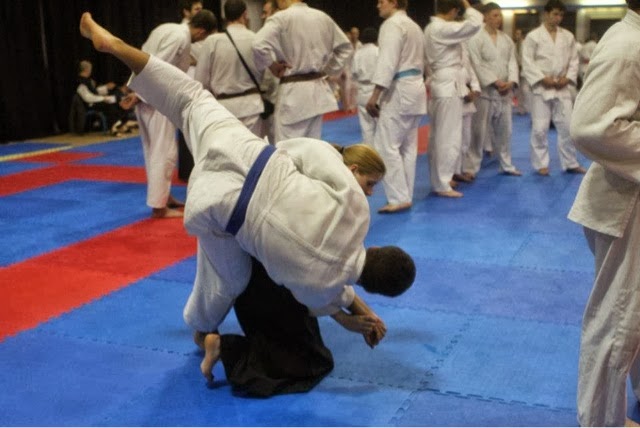
There are no sacrifice throws in Aikido, or Aikikai proper apparently. In doing some kaeshi-waza the other day, I finished the roll and did a nice, lazy, smooth yoko sutemi. I throw this young student, and he looks me in the eye. "That was straight-up Judo. That's not Aikido, is it?"
 
I wonder when that happened?  It used to be that a martial arts master had a particular favourite skill, or maybe had to answer to the boundaries set by their environment and times.  Knowledge was kept from rivals; knowledge was not refused.  This vision of proprietory skills and information and dogmatic refusal to learn anything outside of a narrow world view has nothing to do with our history, nor the history of any martial art.  As we in Aikido train to work with multiple attackers, any technique that involves reducing our mobility is undesirable.  That does not mean that we never lose balance, never fall down or never find ourselves working from a disadvantage.  Warriors developed new variations of a technique to answer to their circumstances and give themselves a slight advantage.
 
In the CAF, Kawahara Sensei had shown sutemi on a number of ocassions. Not every seminar, but about once a year he would throw some out for us to see.  Maybe it was partly that we had icy or muddy streets for 7 months of the year or more. I learned these were seldom used, and did not leave you in a desirable position. This was never an opening move, but rather a belated response to being thrown. This was Kaeshi-waza, or reversals. Kaeshi-waza was for senior students, and not a required element until Ikkyu.  Reversals could happen at any number of points during a kata, and being this late was not the goal but rather a reality we might need to acknowledge. 

Fun cool fact:  We don't need to learn anything different.  Any of our traditional ukemi is the platform for a number of throws, locks and strikes from the ground.  We just need to focus on maai and kuzushi.  Above all, we need to be receptive to the movement being applied to us so that we can best use this incoming force.

Morihei Ueshiba was a Judo student for admittedly only around a year, but he never did much of anything halfway - a year for him was probably more than 3 years worth of hours in training for any of us. I don't know what his rank was when he moved.  Several of his students were also students of Kano Jigoro, so he would have been well exposed to the theories and techniques of Judo and other arts.  Aikido Journal and Youtube have some brilliant clips of Aikido Sutemi-waza in schools descended from students of both Kano Jigoro and Morihei Ueshiba. 

This one clip of O Sensei in his 50s shows him doing a version of a sacrifice throw around 2:42. He is pulled out of seiza, and throws from on his back.  The Noma dojo photo shoot shows the same technique.  This is not a Judo technique to my knowledge.


If you look up the dictionary definition of a sacrifice throw, "putting oneself in a disadvantageous position to throw someone, LIKE falling (I read that as not necessarily falling)" then all of this dropping to one or both knees which seems to be much more popular these days starts to sound like a sacrifice throw. All of the multiple attacker work, all of the disarming an armed individual, all the hanmi handachi - isn't this all putting ourselves at a disadvantage and going forward anyway?  A way of deliberately forcing ourselves into a disadvantageous position and taking advantage of a disadvantage?

Wednesday, October 9, 2013

Snake Creeps Wayyyyyy, Wayyyyyyyyy Down - what is "martial?"

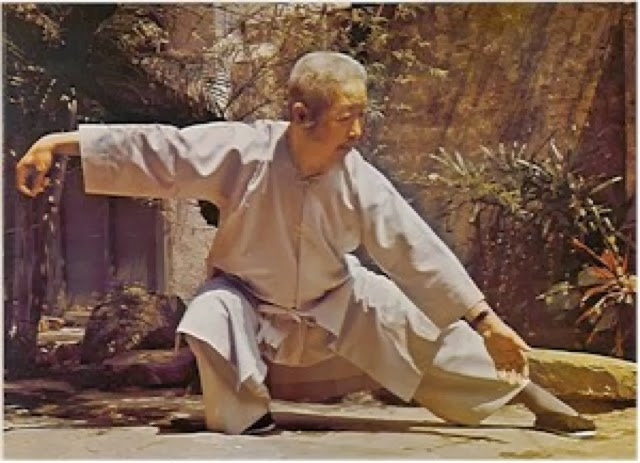
Yang Chen Fu, third generation Yang Style Taiji master doing Snake Creeps Down
Chen Man'Ching, most noted for his short form and his years spent teaching Taiji in the USA, also doing Snake Creeps Down.
Eventually, "good technique" seems to involve straighter legs and a lower butt.

I don't know who this is.  This is also the same posture, and this gentleman's flexibility is very impressive.  

When I hear someone talking about wanting to do a "more martial Taiji," this last picture is what they seem to be referring to.  The thing is, no one fights like this.  This last posture is for extreme stretching, which can aid martial ability, but is not for combat.  The last picture has more in common with Yoga and dance than combat.  A number of other martial arts like Aikido and Karate have adopted a more extreme Wu Shu type approach to form work - lower, wider stances, higher kicks, more jumping, more aerobics and gymnastics.

Most of the actual applications of Snake Creeps Down have more to do with Judo type throws, or a drop step.  Some will resemble sacrifice throws:

While the movement in the form has a person stand up, this application has someone stay on the ground.
Chinna is possible with the handwork.  You can lock the arm, or legs, or neck.

Just throwing this out there for people who want an actual martial idea of this movement.  How come all the Judo pics?  Any Taiji person who talked to me about these applications only described them to me - no one ever did this in push hands to me.  This is how I have come to understand this movement.  

More extreme postures can lend themselves to developing an aspect of martial ability, but that doesn't make them martial.  People who actually used and discovered these applications were often wearing armor and on a variety of surfaces like mud or ice or uneven ground.  The posture is now judged for it's aesthetic appeal, not for how the application would work.

Thanks to all the impressive martial artists who posted these pictures online.


Wednesday, October 2, 2013

Motions of Non-Confidence - Old World Government Reform

I started a blog for martial arts and baking.  I am not really all that qualified to write on these topics.  I am much less qualified to be a political critic.
I enjoy living in American.  The USA has been good to me.  I enjoy working in health care here.
When a Canadian talks about “American Style Politics” we have a definite image coming to mind:
Sarah Palin and Nancy Pelosi engaged in Satanic ritual and sexual abuse of aborted lesbian genetically mutated poodle-pittbull crosses?  Obama and his Muslim love child from Mars in a hot threesome with the president of Afganistan after they discuss the DEATH OF AMERICA?  We'll let you know the truth (sort of)!  News at 11!
After the CBC, the US news is far more titillating - and exhausting to watch.  It seems to be for entertainment, not information.  I am one who feels the Daily Show is some of the most informative programming out there.
I am not endorsing either party, nor am I for or against The Affordable Care Act, otherwise known (as are too many other things to count) THE DEATH OF AMERICA!!!!!!
People ask me what I think of “Socialized Medicine.”  We call it Public, not Socialist. Bureaucrats telling me what care I can receive?  Bureaucrats telling me how to do my job?
Whether they are politicians or CEOs, I don’t always notice the difference on the front line. Someone who doesn’t know how to use a needle is telling me how to be a nurse.
When the Minister of Health takes office, we get all their contact information.  We know who they are, where they work, how to find them, what they look like, their email and phone number.  We can complain to our government if something goes wrong.  We can campaign for an increase in coverage, or the coverage for a new procedure.  They are elected officials with a riding they must answer to, and a campaign can be launched to cost them their seat in Parliament.  They are public servants who serve at the will of the people.  And, at our will, they can be fired.
Try that with the CEO of Blue Cross/Blue Shield.

There are other details in the Parliamentary system that I miss:
1.       The Deputy Prime Minister has a riding.  This person must win an election.  The Vice President, second in line to command the world’s largest nuclear arsenal is someone no one actually voted for.  Third in line, the Secretary of State, is someone no one voted for.  I really thought that the running mate of a Presidential Candidate was going to be picked from someone who had campaigned to be the leader of the party.
2.       The Prime Minister’s Cabinet is made up of elected members.  By convention, the Cabinet ministers are picked to represent every area of the country, much like the US Senators do.  The President’s cabinet is an appointment of people who no one voted for.
3.       The person who is the leader of the party to come in second in an election becomes the Leader of the Opposition. There is also the Leader of the Third Party, and so on.  There is an official residence for the Opposition Leader.  Someone loses the election, and we see them in Parliament for years as the Opposition Leader.  Each member of Cabinet is also facing an Opposition Critic.  When someone runs for office, we know their stances on issues, how they speak.  We have seen them in action. 
In the US system, everyone who wants to be President is essentially untested.  No matter what their experience level, running the largest democracy and military in the world is a huge step up in responsibility.  They were a Governor?  A Senator?  That’s like applying to be the CEO of Walmart based on your experience as a corner store owner.
4.       Also off the point above, Canadians can point to who represents their party, their region, and their interests.  Canadians might complain about the validity of this as we aren’t perfect, but:
a.       When the Democrats are in power, there is no official Republican Opposition Leader who represents the (potentially) 49% of the country who voted Republican.  If the Republicans win, there is no official Democratic Opposition Leader.  Half of the USA can complain that they don’t have representation at the top, and feel disenfranchised.  There is some truth to this.  The Leader of Her Majesty's Loyal Opposition is a very important job that I think the USA would do well to implement (no, you wouldn't need to adopt the Queen.)
John McCain, Al Gore, John Kerry and Mitt Romney would be very important, very visible politicians of considerable influence in the Parliamentary system.  I think that would be a good thing for America.
There is one final difference that I miss that is not merely Canadian.  It is a piece of legislation that is also adopted in other countries like Germany, Britian, Spain and Israel in various forms.  I think it is time for Americans to consider what the planet's oldest democracies have had to adopt.  No Confidence.  
Again, I can’t vote in an American election or a Canadian one right now.  I am not endorsing either party.  Non-Confidence is a check and a balance on the power of ineffective legislators, and a way of ensuring the job gets done for the people.
In law, a motion of no confidence is a parliamentary motion which when passed would demonstrate to the head of state that the elected parliament no longer has confidence in the appointed government.  The first vote of No Confidence in a British Parliament was when the American war of Independence was successful.
Sometimes, the government will choose to declare that one of its bills is a "motion of confidence". This may be used to prevent dissident members of parliament from voting against it.  A core piece of a party’s platform and a major election promise like The Affordable Care Act, the Bush Tax Cuts and the Patriot Act would have been motions of confidence.
In the Canadian Parliament, a failed budget automatically a requires a Motion of Non-Confidence.  A successful Motion of Non-Confidence means the resignation of the government or dissolution of Parliament.  A government that cannot spend money is hamstrung.  Some negotiation and revision is possible a set number of times, but the budget must eventually pass by law.
There are several implications of this:
1.       It is not possible in Canada to continue the government without an annual budget being submitted.  Every budget can potentially trigger a new election.  The USA has not had a budget approved since 2009, with no consequences.
2.       Every year is a potential election year.  No threatening about 2016 while not allowing the government to pass legislation.
3.       Elections are not scheduled.
4.       No Elephants versus Donkeys, it's-not-my-fault mentality.  If you make a budget fail, either by being unable to pass it or by successfully challenging it - you answer to the people in a general election.
And, 5:  the election happens in two months.  No screwing around for four years waiting.  No years long election campaign.
Democracies older than the USA did not start with No Confidence legislation, but through circumstances they have been forced to concede power to the electorate.  Try some Old World style reforms.
Today we can giggle and moan at the silly posturing, and we can stop welfare checks to people the Republicans hate anyway, and close National parks (in October, not July and after any summer vacations), and the TV commentators can have their glorious apoplexy.  While the Congress continues to collect their checks.  And accrue their pension savings. For not working.  Until 2016.
If the election doesn’t happen until 2016 – three years of no governance?  Three years of no expenditures?  Three years of political snits?  Those in power were hired to do a job.  No other job in the USA exists where you close the shop (that you don't own!), refuse to show up for work, and still get paid and keep your job.  
The whole world expects better of the largest democracy on the planet.

Friday, September 27, 2013

Do Nothing Different (Differently)


This was a bit of fluffy video that I was going to discard.  With all the four corners stuff from before, here's a an example of how I would apply it to holding a sword.  I just threw this together on the spot the same day that I did the ushiro stuff from Shirata Sensei, so obviously the sword cuts are for someone coming up behind me.  The same idea is possible for someone in front of me, the sword work would be just a little different.  I did all Doh cuts, but no reason to not be doing Shomenuchi or Yokomenuchi.

When you hold a weapon, does everything change?  Or have you practiced the same skills you would use with a weapon every day of your training?

Sunday, September 15, 2013

But the Trilogy is Over!


Sauron's Tower starting to fall from Return of the King, the third installment of the Lord of the Rings


Emperor Palpatine's statue being toppled from Return of the Jedi, DVD special edition.  The third installment of the original Star Wars trilogy.

 
I've sometimes wondered at the blatant use of imagery in this scene from the Iraq war.  In the years that followed, I wonder how many people were complaining that this scene from the end of movie trilogies was being played out, but now there was a book 4?  Book 5!?  Book 6!?!  The story isn't over yet?!?  WTF!!!!!!!! 
 
Some critics of Robert Jordan's Wheel of Time series have commented on how long the books keep dragging the story out.  "The author is just being greedy!"  In an age of trilogies, a man who was a graduate of a military college started to write a story about a world war and the story got long.  More characters introduced, more characters dying, more complexities and simply having the protagonist be the most powerful on the battlefield wasn't enough to tie up the story with a pretty bow in 300 pages or less.  "How are we supposed to make a movie under 3 hours with this material!?!"
 
I'm looking forward to Book #12 of the Wheel of Time (if you don't count the prequel, which would make this #13).  The war story that Robert Jordan foresaw outlived even the author, who had to give his notes to Brandon Sanderson to finish after his untimely death. 
 
Was Robert Jordan being greedy?  Or did he maybe know something about the truth of war that we might do well to never forget? 

Stop playing games.


Miyamoto Musashi and Sasaki Kojiro were famous samurai from the late 1500s.  Their match was arguably Musashi’s most famous duel.  It was also apparently one of Musashi’s last lethal duels.  Eiji Yoshikawa tells the story very well, but his version is still historical fiction rather than 100% fact.

What interests me about the story is that centuries later, Kojiro still has his defenders.  He was famous, and very skilled.  He lost.  Most versions of the story still temporize and somewhat dismiss Musashi’s victory.  Depending on the version you hear or read:

-          Musashi showed up late

-          He insulted Kojiro to drive him more crazy

-          One version, Musashi waited until Kojiro had his famous “Drying Pole” cut shorter – Kojiro was using an extra long battle field sword for years, then had to switch to a shorter Iaido type blade largely out of social pressure.  Kojiro’s skills were with a longer blade.

-          Musashi whittled a bokken that was longer than he knew Kojiro’s sword would be, allowing him a lethal shot while Kojiro couldn’t quite reach him.

-          Some versions say Mushashi positioned himself so that the sun was in Kojiro’s eyes.

 
Musashi was famous for using every advantage, so he probably made sure he was close to the surf with the firmer sand and tried to leave Kojiro either in the water or in the dry sand.  Kojiro had spent extensive time in the city at this point, and not on the beach.

So, Musashi was not credited clearly with the win, and he was also declared a coward for jumping back in his boat the second Kojiro hit the ground, making a quick getaway before Kojiro’s students could take revenge.  Musashi was a “cheater.”

The various versions out there are statements on Musashi’s time.  Wartime had passed.  The samurai’s abilities were about politics and social stature.  Victory and defeat were secondary to Honour.  Honour was a form of social control that those in charge could bend to their needs.  Rules could be broken.  Someone could train for years under their superiors to develop a weakness that their superiors could exploit in a second.  Low ranked samurai had their weapons removed and were left in Seiza while their superiors had cushions, chairs, or the right to stand.  Paranoia was a virtue.

Why is Musashi not simply the guy who killed Kojiro?  Why is Kojiro not simply the loser? 

Why qualify successful combat at all?  This comment on my blog about Tomiki and Ueshiba O Sensei:

A little known fact is that Ueshiba trained in judo under Kiyoichi Takagi from age 24 to 26 (before taking up Daito Ryu). Thus Ueshiba had an advantage because he knew the judo repertoire and how a judoka moves, whereas Tomiki knew nothing of aikido. A good guess is that Ueshiba neutralised Tomiki by preventing him from taking a jacket grip.


Not what you would call a 'win' by normal standards

 
Kenji Tomiki lost.  Tomiki decided, and apparently his primary teacher Kano Jigoro agreed, that Ueshiba O Sensei was someone worth studying with.  Respecting Tomiki Sensei is not reason enough to denigrate Ueshiba O Sensei.  Ueshiba had more education?  That's not cheating.  Ueshiba didn't play the Judo game rules and fought like an Aikido person?  That's not cheating.

I remember watching the Olympics last summer.  The female Gold Medal Heavy weight match had two experienced wrestlers who had faced off many times.  The Japanese wrestler let the Canadian wrestler hit her in the head several  times.  Her head was down and far forward, her hands and knees were back.  There were penalties for not attacking, so both would wait until one or the other would face a penalty.  To touch someone’s hair or head or perform a striking action was a penalty.  Finally, the Canadian could not afford another penalty, and faced with losing to the rules she held back, and soundly lost.  So, sticking your head forward at waist height with your hands unable to defend yourself against blows is a “Good Strategy.”

One of the Judo silver medals was won by a young man who defended himself by landing out of a throw on his face.  A point is won by having someone land on their back (full point) or on their side (half point).  So, landing on your face is a “Good Strategy.”

Boxers can enter grappling range and hug someone, because throws and sweeps aren’t allowed, knees to the groin aren’t allowed.  So, hugging someone and standing still is a “Good Strategy.”

Olympic Tae Kwon Do was frustrating to watch.  Two seconds of movement, a split second close enough to make contact.  A foot flies upward.  Someone demands a camera replay and everything stops.  The foot is seen to brush a single toe against the head gear; the person “kicked” in the head has not been moved, nor stumbled nor suffered any apparent trauma nor even impact.  Victory!  Nevermind the part where high kicks are more points than sensible combat, throws are illegal, contact below the waist is illegal (but your opponent has a large below the belt surface area effectively above the belt for a large portion of the match.)

In our combat games, there has always been a problem finding a way to make training safe for both partners.  Someone who cannot fight their way out of a wet paper bag in their 40s because they were too brutal in practice in their 20s missed the boat in my opinion.  Just like training for rules, training to be a cripple is training for eventual incompetence in combat.  MMA started as a relaxing of the rules, but now has safe terrain, no weapons, one on one, illegal techniques, weight classes, gender classes…mostly driven by a need for safety, but some rules like maximum grappling time limits were because the crowds found it boring to watch two sweaty guys laying on top of each other.

I am not questioning the athletic ability of these Olympians, nor the effectiveness of their arts.  I certainly don’t want to fight them.  It’s the rules so solidly in place that they are now defining dogmatic characteristics of who we are as martial artists.  It’s the lack of acknowledgement by some to say that all combat games are faked; whether to focus on a specific skill, or for health or safety.

Now, the people with nuclear stockpiles that can obliterate the planet have decided that chemical weapons that could obliterate the planet are “cheating.”  Same with biological weapons and plagues.  “We don’t have it so you better not.  Fair combat is what we can do to you, and you better not even try to develop the ability to do what we can do or we’ll call a foul and bomb you before you can challenge us on equal footing.” 

I think this is one truth that Morihei Ueshiba was absolutely correct about:  testing, competing with and criticizing others weakens us.  Legislation, sanctions, “limited” military action and speeches are not peace; they are a substitute form of violence.  When the first atomic bomb landed on Japan, I believe O Sensei learned we can’t always hide behind the “rules.”  Treating life like a damn game is a way we try to pretend there are no consequences to our actions and choices (and non-action is a choice!)  There is no referee to call foul, and there is cold comfort in having our friends write a favourable obituary.
 
It's not a game.  Stop acting like it is.

Saturday, September 7, 2013

"Don't blame me, it's just the Rabies talking."

We train to create a reflex.  Reflexes by definition are triggered by perception that the spine and not the conscious mind responds to.  We don't choose to flinch.  We might need to train poor reflexes out of ourselves:  it's not always helpful to fall into an infant startle reflex or fall into the fetal position.  Relaxing into good posture and awareness, full body connection - this is a good reflex to develop.

The USA decision to have people register their hands as lethal weapons is a little contorted in my opinion.  The idea that a reflex has been so engrained that I slash someone 30x with a folding knife in my pocket before I consciously think - this is the public image of this claim, and I think it insults us all. 

I met a security guard once who laughed and bragged that when he was playing a friendly game of water volley ball with his family, a relative of his jumped up for the ball and "our hero" responded to the person falling towards him with a palm strike that shattered the man's nose.  I think I remember other listeners saying, "oh, good Mushin!"

Musashi was able to cut without conscious effort to raise and lower his sword, but he was a brilliant tactician.  He wasn't a slave.  He was a genius and a top level manipulator, not a brain-dead robot.  Chinese arts take about Wu Wei, and in Aikido we talk about Takemuso Aiki - the spontaneous creation of martial technique.  This requires a free mind, a mind that embraces all possibilities.  Mushin is often defined as "No Mind," but this is not something to confuse with "Brainless."

A good reflex to draw a weapon.  A small step further to pull a trigger.  Hands up, making a fist (if part of your system), making space- but hitting someone in the face a dozen times?  Breaking a neck?  A stray punch can crush a throat I suppose, and kids in hockey do end up dying from a hard slap shot puck to the chest so why not a hard single punch.  An accident can happen; this is different from not taking responsibility for your actions because of "your superior training."  

Who you are shouldn't change.  If you want everyone safe, but see the need to make a choice, your response will likely be proportional.  Soldiers cannot hesitate on the battlefield, and they need to shoot to kill.  But, if a hypothetical soldier pulls a trigger and takes out a school full of children?  We don't credit his training.  We'd court martial him, maybe give the death penalty.  At our most compassionate, we call him sick and confine him.  We don't hold this soldier up as the ideal we should strive for.  We expect a proportional, reasonable and planned response.

I work in health care along side some great martial artists.  Their general health, determination and ability to override their stress and function well and remain calm makes them great caregivers.  I know MDs, PTs, OTs, CNAs, EMTs and many others with martial arts backgrounds.  One of the nicest RNs I ever met left us for a year to be a combat medic a few years ago.  Their emotions don't override their intelligence.  "We forge our minds and bodies in the fires of our will!"  Who wouldn't want someone like that backing them up in any profession?

If a weakened patient started yelling and flailing, and the nurse responded by breaking the patient's nose, the nurse would be fired.  We would not brag about Mushin, we would call it poor emotional control and a lack of impulse control.  We would not call this nurse a higher level martial artist.  We would call him a rabid dog.

The thing about rabid dogs - we don't say, "this is a good dog, just the rabies is responsible.  I want the dog to be rabid, because there's a good time and place for the rabies."  (However rare that time and place might be.)  

We shoot the dog.

Don't brag, "It wasn't me, my training took over and it just happened!"  If you are a slave to your training, then retrain yourself and be the one in charge.