Blogs I love to read:

Saturday, April 25, 2015

Aiki-Freudians

I came across this article  written by a Yoga teacher.

I love her approach.

I was in a seminar with a teacher I never met before.  I took ukemi for a Shihonage Ura version and felt my entire folded arm from my shoulder to my wrist in contact with his abdomen.  Then, we broken into partners for practice.  I moved as best as I could to replicate what I had felt, having not actually seen the technique demonstrated.  The teacher ran over, yelling angrily at me in front of the class.  Not telling me to practice more slowly, or more safely, and definitely not telling me that he had taken an extra step to close the distance between him and his Uke - a unique variation that I had to steal.  I forget the words he used.  Something that communicated along the lines of:  my soul was a black fetid pit and that no one would ever love me for the rest of my life.

It happens.  I've seen it happen to others, and it wasn't the only time this happened to me.  I'm not clear what benefits are to be derived from such discourse.  How is this type of "feedback" actually seen to be helpful feedback?  "You'll never be able to do Katate Dori Tenkan properly until you've had a decade of psychoanalysis?"  Maybe the teacher is hoping the student will quit.  

I've had Aikido, Yoga, and Tai Chi teachers fall into psychoanalysis and it's ugly.  For starters, the years involved in getting a black belt very rarely involve training to be a therapist or a substitute religious leader.  But, as instructors we are responsible for several aspects of a student's growth as a person.  Something happens, and becomes a reason to pass judgement on a student's psyche.  Paraphrased, usually "You're a cold-hearted, overly aggressive, viscous person who doesn't have emotional and spiritual depth."  Sometimes the comments are worse.  It's character assassination masquerading as "help."  I've certainly never seen a student become a better, more well adjusted individual as a result of being singled out and derided even if the comments were accurate.

I'm certainly not saying that emotionally or cognitively harmed individuals don't find their way to the dojo on occasion.  I've seen people bearing scars of emotional abuse, or people trying to find a way to better deal with stress, anger management, and even PTSD on the mat.  We offer growth and peace, and people come looking for this who know they need it.  That can lead to challenges on the mat for everyone, and the instructor has to maintain some control.

Emotions and thoughts are linked to our physical bodies.  The Mind leads the Body.  Slouching, hanging one's head, looking at the ground, hands drawn inward or arms crossed - these things are associated with a negative emotional state like fear, anger, or depression; with a desire to be kept apart.  Looking people in the eye, standing upright head raised with an open chest - this is associated with confidence, or with arrogance and being challenging.

As martial artists posture is associated with improved perception, more effective breathing, better biomechanics, more relaxation and better integration associated with faster movement, improved response time, and more power.  A student might already tend to have a more confident appearing posture due to the sum total of their lives, and maybe their character will reflect this.  There are good, concrete physical reasons for good posture.  It's how our bodies are built to function most efficiently.  And, corrections can often be very concrete or at the very least allow students to save face.

The young man in the Yoga article did have his demons, and had been facing them with some difficulty.  His teacher didn't insult him or break him down further.  She gave him a real gift - acceptance and a way to move forward.  She created an environment for positive growth and gave him a transformative practice through her patience and empathy.  


Wednesday, April 15, 2015

Breaking the mold in Tenkan

From Morihei Ueshiba's Budo:
Precautions for Training (often translated as Rules for Practice)

5.  In daily training, begin with basic movements to strengthen the body without overexertion.  Spend the first ten minutes warming up and there will be no fear of injury, even for old people.  Enjoy yourself in training and strive to comprehend it's true purpose.

Often I come across something recommending Katate Dori Tenkan as that beginning practice.  One thing I remember from Sensei was being shown a very specific way of doing Tenkan, then practicing that way for months, then he would show something very similar but fundamentally different in some way.  Would we be slightly in front, slightly behind, wrapping Uke around us, or still able to face Uke and strike during the movement?

When I go to a seminar, one of the biggest barriers to learning certain techniques is Tenkan practice.  This is a very important exercise, but the solo 180 degree version seems to drive home an exact variation.  This seems to be more of a Tohei lineage practice, but it is common and pervasive.  Then, the mat gets crowded and we fit so much better together to do exact 180 degree Tenkan practice.  There are philosophical ideas like, "See the world from Uke's point of view."

Whether Tenkan is about Redirecting, or Leading, or Blending for a student the movement is about manipulating a relationship with someone else.  How fast, or how forcefully, or how high, or how long is Uke's arm, or what vector Uke moves in can change what Tenkan actually should look like.  If we don't reach 180 or go much further, I sometimes hear criticism of Uke.  Maybe Nage is right where they belong though.

I'm just throwing out a few videos as examples.  Of course 180 should be practiced, but in the "Getting off the Crack" theme (this is another exercise I was often asked to find a crack in the mat to follow).  I started to play with differing circles.  An Ikeda Shihan student showed me to do Tenkan to 135 degrees, and this works very well for Kotegaeshi leads for me.  Morote Dori Iriminage Chudan works much better for me if I open to 90 degrees - really, coming directly from the side is the weakest angle for Uke's stance.  I love so many of the 270 degree projection turns.  One visiting teacher loves to do Shihonage Ura with a 450 degree opening.  When I watch YouTube of any of the greats, 180 seems to have specific utility.

I just enjoyed giving myself permission to go a little less or a little further - back to something similar to Four Corners.  I was surprised to find that some movements got more effective.  I have videos here of shallow movements, but of course there are many examples out there of people turning much more than 180.

Yamada Sensei doing a 90 degree Irimi Tenkan


Wednesday, April 8, 2015

Getting off the Crack

The Yang Family San Shou as taught by Chen Man'Ching was a very strange form for me to see for the first time.  Often times the San Shou paired form is taught as a solo exercise, and even then the movements bear little resemblance to the Solo Yang 88 move long form.

I learned the long form pretty much as demonstrated - repeated Wave Hands Like Clouds and repeated Repulse The Monkey movements could be done back and forth in a narrow hallway.  The same is try for Wild Horse Parts Mane.  In fact, I do remember picking a crack on the floor and following the crack across the room step for step.  


The performer is almost always facing forward or posing with the left or right profile as though demonstrating to an audience.  Movements like Grasp Sparrows Tail face the same compass direction repeatedly.

Rules are out there like always beginning and ending in the exact same spot, or taking the exact same amount of time with each repetition of the form.  Eventually, the choreography gets more strict.  The pattern the form makes on the floor is an important part of the form in several different arts.  Arthur Murray style dance step diagrams start to appear.

Arthur Murray

From Nakayama's Best Karate series, Book 5

I guess what I found so weird about the San Shou form when I compared it to the solo form was the constant change in weighted leg, moving off the line frequently and setting up a stronger attack angle, constantly changing the spatial relationship with the partner.  Years of basic push hands had taught me Aikido and Taijiquan were different, but the San Shou certainly shows Tenkan, Tenkai and Irimi Tenkan movements.

I use this to justify my "getting off the crack" when I do my long form now.  I get off the line and push to a variety of angles and I try to fit my movement to an imaginary partner rather than a chart on the floor.  I don't try to root in place, and I sometimes think I am closer to the intention of the form because of it.  Why not let my form move to a different direction?  Of course, I often go back to what I was first taught, but bringing the advanced form ideas to my basic practice has been illuminating and fun. 


Wednesday, March 25, 2015

Glima

Something is interfering with me making links, I'll clean this up in the future.

Glima


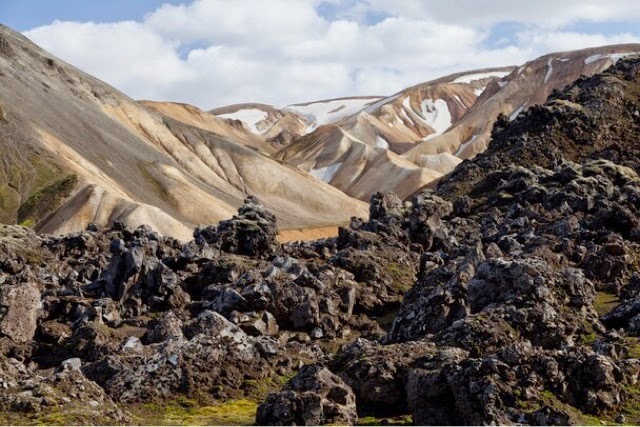
Iceland is a gorgeous country, certainly the most breath-taking I have ever seen.  From the volcanos, waterfalls, mountains rising from the ocean to perfect pasture dotted with jets of steam and moonscape dotted with glacier - it was amazing.  Everyone was wonderful and friendly.  I ate lamb stew every day, washed down with a malt soda.  

I hadn't actually known wrestling, or Glima, is Iceland's national sport.  Earliest known references to Glima go back to the year 790 A.D.  Thor was the Viking god of wrestling.  The Viking's martial prowess was passed down as entertainment and sport.  Combat skills took several forms like water Glima where competitors would control their opponent under the water until they submitted.

Wikipedia and it's sources have some great information here  

The landscape of Iceland has some areas that look very nice to fall on:


And some that look like no amount of practice falling would have me escape injury:

Some of the water is not for swimming - glacier rivers were cold enough to take my breath away,  yet we ate at a few restaurants that cooked over geothermal vents, and there was a park that boiled eggs in a geothermal pool for the tourists.  We walked across glacier to a mountain peak uncomfortably hot to sit on, where we ate sausage cooked in tin foil buried in volcanic ground.  Water comes from the ground boiling, and signs like this are easily found:
                                     It would be a short swim if you got thrown in.

The one area close to where we stayed had a restaurant and a memorial to a famous Icelandic Glima master.  Videos were playing constantly on a TV in the corner, and I enjoyed watching them.  

Like other arts, Glima has the same human anatomy to work with.  One of the rules, "Don't look at your opponent at all," is much like an exercise my wife will briefly do at the start of her classes.  We are supposed to learn to move by feel in any grappling style, and all arts seem to have some form of drill to train this be it wrestling with the eyes closed, or blindfolded, or in the dark.

Another rule, "Don't land on your opponent," effectively rules out any Makikomi or Uke-Gatame techniques.  Staying upright effectively rules out a ground game - but in a land of boiling water, serrated lava rock, icy oceans and steep high cliffs keeping one's footing is life and death.  Certainly, Judo and another grappling styles have a strategy of staying standing where possible and ground work is a secondary skill.  This helps to emphasize the initial grappling phase.  In Aikido, staying upright is a mandatory strategy as we practice for multiple attackers.  Most Viking weapons like swords and axes are best deployed from standing.  Strategy and philosophy aside, I weigh 220lbs (100kg) and if I went from standing to dropping my full body weight knees first on to someone's chest, I could hurt someone.  So, staying standing is a safer practice for both me and my partner.  (Interesting for me, in practicing to stay standing I can better aim and time a knee to someone's chest).  

The mandatory grip is on the specialized belt that resembles a climbing harness.  This would historically control a scabbard and someone's ability to bring a weapon to bear.  For modern competition, this means no strikes and of course there is no weapon to control.

It is a great exercise that certainly trains some specific and isolated combat skills, but the basic competition Glima is not the brutal fighting style of 1200 years ago.  Combat Glima itself was outlawed in Iceland for 100 years as injures and deaths were too common.  Definitely to Glima's credit, it survived when many other martial arts and entire cultures vanished.  While associated with Thor and the old Viking religion, Glima survived Iceland's conversion to Christianity.  Few other martial arts, maybe Sumo 

http://www.sumotalk.com/history.htm


or Pankration 

http://en.m.wikipedia.org/wiki/Pankration

can claim such a history - and both of these arts have been modified over time.  Glima remains a national sport and taught in schools while Canada's national sport of hockey is being accused of being too injurious even for professional athletes.  

I guess I'm looking at a brutal combat system over a thousand years old that has been changed for safe practice and learning.  As an Aikido student, I am told we are so much less martially than we were.  As a Taijiquan student, I am told the art is so much less martial than it was.  Both of these arts are far, far younger than Glima.  I wonder what Aikido would look like in 1000 years?  Or Taijiquan in several hundred?    

Glima 2005 championship

Archival Glima footage

1932 Glima footage

Enoksen Combat Glima


Saturday, February 28, 2015

The Basics

Going through the history of Aikido language in a very cursory fashion, I realize I was more after an understanding of the art in general.  Really, it looks like different teachers had different ideas of how to teach and what to teach.

All the groups ultimately want to improve the world and the people training in their Aikido.  Everyone claims martial efficacy as a goal.  Takemuso Aiki, the spontaneous creation of Mushin technique, is something pretty well every branch of Aikido, if not every martial art in the world holds up as a goal.

The question is How.

Our English language has 26 letters, 5-7 vowels making 20 separate vowel sounds with a total of 44 sounds, and a pile of grammar rules that many experienced English-only communicators frequently mangle.  Our written language is represented in calligraphy, cursive, printing, and an ever increasing number of font.  We have jargon for specific uses and groups.  We have dictionaries and thesauruses (thesaurasii?).  And, we allow poetic/artistic license anytime any of the rules don't serve us.  But, we start written English with 26 things that can expand eventually to Dick and Jane, Ulysses, a Brief History of Time, and the Bible.  26 things that give us unlimited potential.

When we learn mathematics, we learn the language of the universe.  Physics bears witness to all creation.  The greatest mathematicians still started with 0-9, then learned how to manipulate them.  Ten digits that can be used to predict the weather, the seasons, the depth of the ocean, the power of the atom and the location of interstellar bodies.

The most basic and most powerful computer programs all are derived from 0 and 1.  Like the Yi Jing, Wuji (Nothing) gives birth to Taiji (two things - something and the absence of something), the Four Symbols, the Eight Trigrams, the 64 Hexagrams and so on all the way up to limitless.  Whether it is Yin and Yang, or Binary machine code, two things can eventually lead to potential we have yet to fully realize.

The Founder and his teacher apparently didn't build on basics so much as dropped the equivalent of astrophysics on their students and left them to figure out how to frame their own insights and communicate to their students in turn.  Maybe it's not surprising so many people developed different ideas.

Saturday, February 21, 2015

More of what is in a name - Omote and Ura reconstruction

O Sensei himself was not regimented in how he taught, and apparently neither was Sokaku Takeda.  For the students who followed them, the well formulated methods of teaching that Kano Jigoro successfully advocated for and successfully implemented nation wide for Judo probably influenced everyone to some degree.

(Not necessarily directly, though Kano shared many students with Ueshiba.  I mean more in the same way that BJJ and MMA has forced everyone to consider their ground game.  Kano arrived in the scene with methods that helped students and teachers clearly understand what was being taught and how well the student was progressing.  The promise of understanding within years, instead of decades of chaotic instruction must have had huge repercussions and mass appeal.)

There are separate associations with their own names for techniques.  The wide variety of practice methods out there would seem to indicate that O Sensei's teachings were very different for each student and a wide variety of technical expressions were tolerated.  

Wide varieties in names were also apparently tolerated or eventually came to be.  For example, a very rudimentary wrist twist is known as Kote Mawashi, Nikajo, and Nikyo in Aikido alone.  It exists in some form in every martial art I have every seen demonstrated, with many different names.


One technique I was required to learn was called both Ikkyo and Nikyo Omote.  I never learned how to distinguish which was which.  This picture is labelled Ikkyo below, and this is the technique I am referring to.


I learned this next one as a Wakigatame.  Someone asked Sensei if it was Gokyo, and I remember him saying, "No."  Another higher ranked direct student of O Sensei I met a few years later said, "Yes."  Here is a picture of Shioda Sensei doing the same technique, labelled Nikyo (by an American dojo - Shioda used Nikajo to my knowledge, and maybe never used Nikajo for this movement.  The point is how badly we communicate within our collective art).  It appears in Daito Ryu, but I don't recall which catalogue or what it's name is.


As people were coming to train with O Sensei with a wide background in traditional martial arts, many techniques in the Aikido syllabus already had multiple names.  The student could fall back on terms stemming from guarded family arts, insular clan arts, as well as exposure to the martial arts of other countries including Okinawa, China and Korean.  If O Sensei didn't provide the name, the student already had a framework for labeling the technique.  Look up words like "walk," "stand," or "hold" in an English thesaurus - I am glad to have only a handful of Japanese terms for these subjects!

Names eventually became "correct" as declarations of allegiance to political bodies especially in the West.  Language barriers probably played a role.

To a native Japanese martial artist, the names might very well be completely interchangeable - most of the Japanese technical terms like Kote Mawashi are very rudimentary and describe the movement, offering no deeper spiritual meaning.  

If that is the case, the fault isn't really with the Japanese labels but rather in Caucasian monolingual nobodies like myself who are trying to learn "Thee Right Way."

Friday, February 13, 2015

From the Sword

have been told many times that my style of Aikido comes from sword work (not by Sensei, and I think it isn't a fully true statement and maybe becoming less true with time).

The problem is, I had little sword work coming up compared to some associations (more than some, but not a lot).  So, I was left in pre-YouTube and Facebook days to watch movies and read books.  Kata practice also left me with a sense of an extended and protracted contest.  There are other fighting styles from different cultures who try multiple rapid cuts, but the theory is most of those cuts are going to fail to do much.  Most Japanese arts seem to try to be minimalist - one move, one kill.

I was raised on Darth Vader, Obi Wan Kenobi, and Luke Skywalker.  I was blown away by The Princess Bride.  I caught Revenge of the Ninja in the theatre as a new release.  Choreography has since become more lavish, wire work more common, computer graphics and clever editing common place.  More Crouching Tiger, more Zorro, more Kill Bill, more Matrix.

This Link shows some Iaido cutting practice.  My understanding is each practice target device is supposed to have roughly the same feel and offer the same resistance as a human arm, leg, or neck.  The wall shaped device would then offer the same resistance as a vertical cut through the torso I guess.  

Each movement is a single, simple, lethal, fight stopping movement.  I watch the final fight scene from Sanjuro, or when I watch Sword of Doom, this is what I see.  There are no blocks, no handsprings, no flips, and it's much less fun and sexy.  It looks quick and lethally simple.  When I watch these scenes with non-martial artists I get told it looks fake (and, these are movies so they are fake) - but the same people don't make that comment about Jackie Chan.  Maybe the idea that we really are that fragile is unsettling.

I remember Sensei saying empty handed Shomenuchi was "Two Kills."  Raise the hand - finished.  Lower the hand - finished.  It's the same movement as Tohei's Ikkyo Undo, as Shioda's Kokyu Ho #1, as Tomiki's Atemi Waza.

This was one idea that I tried to work on leading up to my last test - no meaningless movement, each moment in time an opportunity to strike, lock, or throw.  One move, one finish.