Blogs I love to read:

Sunday, November 24, 2013

Sweep the Lotus: Thoughts on training with limitations for martial effectiveness


Old or injured people shouldn’t have to feel bad about how they train, nor should they be trying for the impossible.  “Know yourself, Do your best, Make a little progress every day, Don’t overdo it.”  I never met Master Jou, but I see the wisdom in his training advice.  This post is about the confusion of athletic and martial/real practice.
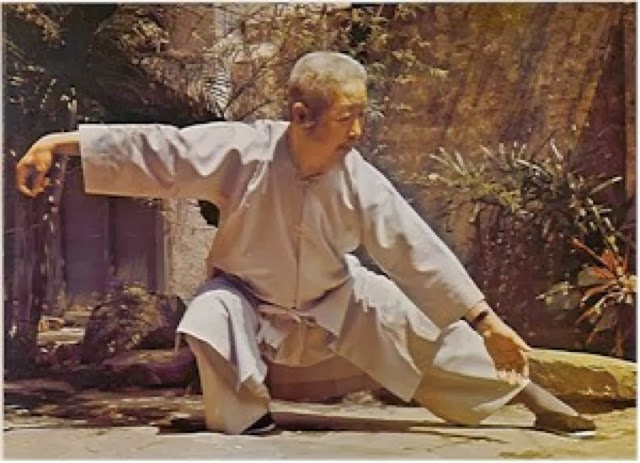
Close to the end of most solo long empty hand Taiji forms is a movement called Sweep the Lotus.

·         Stand on your right leg and move your left leg in a clockwise circle (Outside In).

·         Turn your body in a full circle

·         Shift your weight to your left leg

·         Move your right leg in a clockwise circle (Inside Out)

·         Your arms move together in the opposite direction of the feet

Some teachers do this form full speed and full power.  Their hands loudly make contact with their feet.  As this is by far the most dramatic movement in Taiji, this group of instructors talks about “Ending the Demo with a Bang!”  The application for Sweep the Lotus for these teachers follows Dr Yang Jwing Ming's book on Taiji application:  grab the attacker's face and kick them in the back of the head.  Most students think of doing this once, Dr Yang shows kicking the attacker's skull twice. 
To my roommate’s initial amusement, I bought in to this idea.  I started to practice turning off the lights with high kicks to work on my accuracy and height.  I hit the floor many times, then started to make a mess of the wall and broke the kitchen light switch before my roommate angrily reminded me I did, in fact, still have fingers better suited for the light switch.

Most of the big name teachers do this movement slowly, fluidly, and with less height.  The Two Person San Shou that I learned shows this Inside Out crescent kick at kidney height.  A similar movement in Heian Godan shows the crescent kick moving Outside In to the solar plexus.  Ultimately, I started to practice a slower kick because it was harder practice and it did not matter so much if I changed my clothes first or warmed up.  I noticed I developed a little more range of motion in my hip while not kicking as high or as quickly.

I think another realization was when I started to train with saber and sword – I had bought myself a very heavy and sharpened saber and I genuinely nervous for my feet.  I started to see someone could just slightly deflect my blade as I swung…
I remember the elderly and injured people who loved to practice always skipped the movement altogether, or they looked embarrassed or ashamed that they could not perform the high kick.  Instead of getting this close to the end of the long form as the culmination of their practice, often times this movement seemed to prove to some people that “Taiji is too difficult to do.”  People would see this movement and decide, “I can never do Taiji for real.” 
One Chen Taiji teacher showed me a video of a Grandmaster doing his form.  "Look, Crescent Kick to the Head!"  The 80 something year old gentleman in the video (now long deceased) brought his knee up to waist height slowly and never extended his leg further as he slowly circled his hands.  "He got too old to practice his Taiji form.  He was still undefeatable though."  The student was judging the teacher by his aesthetic qualities, while admitting there was something much more going on.  I learned about the difference between pretty technique and real technique.
I mentioned Shotokan Karate forms earlier as other examples of feet and hands moving together.  Soon after passing your first test, a new student starts to learn Heian Nidan.  The fifth or so movement in, you do a side kick and a back fist at the same time to “punch and kick someone at the same time.”  Legs are longer than arms.  The higher the kick, the more I lean to one side – giving my arm even less reach and less chance of hitting a target.  I tried to strike posts like this, but I never was able to use my hands and feet simultaneously in this fashion.

This type of movement appears many times in the various Shotokan kata.  Eventually I was told I could grab an attacker’s hand and then kick while pulling them into the strike for increased damage.  Difficult to do, and easier if they are grabbing me instead.  It also requires a modification of the kata in application.

A direct student of Funakoshi was teaching a local seminar, and I went.  He was commenting on Nijushiho, but I could see the idea carried into other kata.  Today, the open hand technique was accompanied by a high side kick to the chest or head.  When he was a student, it was taught as grab an elbow, shoulder or head and stomp downward on a foot or knee.  The high chambered knee could be used to strike up before the foot struck downward.  Kata were specifically changed to be made more physically challenging when the idea became perfection physical and spiritual challenge instead of combat effectiveness.

There is nothing wrong with the variation I was made to practice.  Pull someone into a kick, and the resulting force on the target area is increased.  Another theory was that a more difficult movement when practiced makes an easier movement even more easy.  Technical drift is expected in a fight, so train for greater difficulty.  Nothing wrong with the movement, nor the method of training.  It just requires greater balance, greater flexibility and more years of training to even attempt.  Women looking for self defence need to pay attention to their footwear – stomping in heels is easier than a high thrust kick.  This exclusive high kick practice sets a reflex to attempt what maybe should not be attempted.  On slippery or uneven ground, even a senior student would find this difficult.  Maai must be perfect.  Timing must be perfect, and somehow the initial grabbing movement must not telegraph the finishing kick.
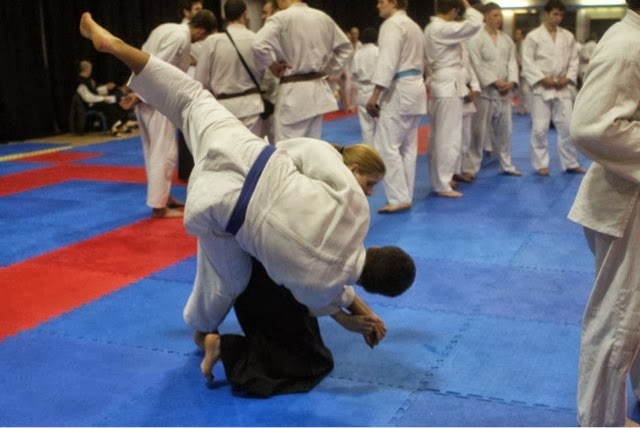
I then had a chance to study some Judo briefly.  The hand and leg coordinated work in Judo showed me how these movements can easily be throws and sweeps.  The thing is, to do these sweeping movements your feet are supposed to be close to the ground. 
So, all you people with arthritis, back pain, knee and hip replacements, challenges to your balance:  if you need a martial justification of a movement that keeps your foot closer to the ground, check out these excellent teaching bits from Windsong Dojo.  I especially found the part enlightening that trying to lift the foot higher is not only unnecessary but often weaker than keeping the foot sliding along the ground.  
Outside in
Inside out
I encourage people trying to train despite limitations to really think about what “martial” is.  In these days of CGI, trick photography and stuntmen on every TV and movie screen, we can become jaded and bored with real technique.  We are told the elite, improbable and impossible is the standard, and then we discourage ourselves.  We stop training because we aren’t fantastical creatures but rather merely human.  The only way to lose the benefit of training - is to stop training.  Get out there and even if your feet are just skimming the ground, or you are just raising your knee and stomping instead of kicking, remember: 
You are doing real martial art.


 Thank you again to the remarkable martial artists who have their images on line for me to find.  I am not doubting nor questioning your impressive ability - I am just wanting to show that options exist for the rest of us.

Saturday, November 16, 2013

A functional definition of Qi/Chi/Ki


Qigong is an Asian-based practice that focuses on using the mind and body to improve health and overall functioning.  It is a practice of aligning movement, awareness and intention for exercise, healing, and meditation.  At the core of Chinese internal arts is a statement found in the Taiji Classics:  “The Mind leads the Body and the Qi follows.” 
The first problem many have with Qigong is Qi.  Qi is often defined as the mystical energy force that is present in all things and unifying us all.  It is simply the definition of magic - mysterious powers that inspire everything from Crouching Tiger, Hidden Dragon to Star Wars Jedi Mind Tricks.  The inability to scientifically prove the existence of Qi is the reason that western science and eastern healing methods have been at odds.  Everything from acupuncture to Reiki to qigong is predicated on the existence of Qi – if Qi does not exist, then all of these things are perhaps called into question. 
The character below is the Chinese character for Qi.  This is the character for “Chi” in Tai Chi Chuan, as well as the "Ki" in Aikido.  The symbol depicts a stove with a fire burning inside.  A pot with rice is sitting on top of the stove and the lid is lifting up.  Very mysterious and not easily explainable centuries ago, but a given fact that the rice put in a pot with water over heat will change.  Therefore, a possible definition of Qi is Steam.  Other possible definitions of Qi are Air and Breath.


It is true that several cultures have developed theories similar to Qi.  The Yogic Prana in India or the Ki in Japanese arts are examples.  This does not help to prove the existence of Qi, but I believe it shows that the concept has been useful across many cultures and centuries.
Science cannot prove the existence of an invisible, intangible, magical/mystical energy field.  However, the so-called "Ki Society Aikido" calls themselves Shin Shin Toitsu Do or Aikido with Mind and Body Integrated.  Other examples of the Japanese use of Ki in language (from Kisshomaru Doshu of Aikikai):
Courage:  Shi-Ki
Will power:  I-Ki
Vigor:  Gen-Ki
Bravery:  Yu-Ki
Equanimity:  Hei-Ki
Conserving Energy:  Shu-Ki
Prolonged Breathing:  Ki-Soku
These concepts are not magical.  Far from it.  These words speak to Mind and Body interaction, and the interaction of our logical mind and our emotional mind.  Most of us accept the influence of our Mind on our Body as factual.
The idea of Qi I use in my classes at the Duke Cancer Center is straightforward.  I am not introducing anything magical, mystical or religious.  Simply:  how we think and feel affects how we move, breathe, and live.  How we move, breathe, and live affects how we think and feel.  We can learn how the Mind can positively influence the Body, and how the Body can positively influence the Mind.  For this Art, I always start with the Mind.
We feel, see, smell, touch, and taste everything with our brain.  Our brain is our gateway to reality.  Anxiety, stress, or Type “A” constant driven desires to succeed are associated with a number of chronic and acute health problems.  Grief, depression, distraction, and anger cause changes in our sleeping and eating patterns, our bowel habits, our ability to perform tasks that might otherwise be very familiar to us.  Panic, rage, and fear cause our heart and lungs to work faster and more forcefully.  Fear makes the experience of pain worse.  Doubt makes us less likely to succeed.  Most areas of medicine make use of psychology, acknowledging of the importance of addressing the mind while helping the body. 
If you attend one of my classes, it does not matter if you believe in an energy field.  You do not need to challenge any belief systems, religious or otherwise.  You only need to accept that the mind and body are connected.  Internal arts use this idea to improve balance, functional strength and coordination in a low stress, low impact training method.  When the Mind leads and interacts with the Body, the two together can do much more than the sum of their parts.  This notion of Qi is common sense, and I teach Qigong that is heavily grounded in psychology and kinesthiology.  
The exercises I teach in the Duke Cancer Center Quiet Room are from Li Family Baguazhang, a martial art.  This is not a class in combat.  There is no fighting.  My hope is that students will have some fun and feel better during, and at the end of class.  These exercises can be easily modified – when in doubt, what you are doing in your mind matters more than what you are doing with your body!  For this art, a mental practice without movement is better than empty, mindless movement.  A relaxed mind is clear and easily focused.  A relaxed body starts with a relaxed mind.  Healthy movement starts with relaxed, mindful structure.  
I am grateful to the Duke Cancer Center for the opportunity to teach this Art.  The support I have received from my managers, patients and coworkers has been exciting and amazing.  It was in part for this class that I am the recipient of the Duke Cancer Center Superstar Award for patient care this year.  It was humbling to stand in front of so many of my coworkers at the 3rd anniversary of the Duke Cancer Institute - I work with many amazing people, and they all go the extra mile.  
I also want to express my gratitude to the teachers before me:  Shifu John Painter has made it his life's work to clarify the mystery around the Internal Arts.  I am a better student and practitioner today thanks to his efforts. It is his methods that I am introducing in the Duke Cancer Center's Quiet Room.
Without the efforts of Kristy Everette Sartin, the Oncology Recreation Therapist whose efforts led to this class, none of this would have ever happened.  Thank you.
As always, thank you to my wife who would define Qi as the most useful word in the history of Scrabble.

Sunday, November 3, 2013

Martial Art training for health?

Training for health is not something Aikido people tend to do - we get thrown all class long, every class  and we keep attacking each other, so the martial, however questionable it sometimes can be, is present.

Taiji and Baguazhang students have self practice as the primary training method.  Many people in Taiji in particular will avoid any mention of martial art.  If you don't like to touch other people or don't like to be touched, you can just say so and never do any push hands or applications.  Training for "health" can be code for training with no intention, no structure, no understanding of the movement (or of movement in general.). I like to insist on some martial theory in my classes.  Martial is often confused/equated with MMA and shouldn't be.  I just look at effective, biomechanically sound movement.

Martial is about good body structure.  Yes, this was first about "How do I hit someone harder?"  But it can be so much more.  How you walk throughout the day, how you close a door, how you carry a bag of groceries or lift up a small child from the ground can be informed by your internal arts practice.  You can become functionally stronger, feel less fatigue, be better balanced and generally become much less likely to be injured in your daily life.  So, I call that healthy.  I tell students, "No one ever taught you to walk.  One day you stood up and didn't fall on your face as you moved your feet.  That's what you probably did for the rest of your life.  There is a better way."

So, I encourage you to explore martial ideas and find out about kinesthiology.  "Lift with your legs, not with your back," is used extensively in Taiji form work.  There's a corridor in front of your body where your arms and legs are much more effective, and your movements are much healthier if you stay in the corridor generally.  Do you know where it is?

Another piece of confusion around training for health has come from competition form work.  When the Chinese government commissioned a form for practice, there was a very specific definition of what a movement would look like.  I get students who try to emulate that form despite their injuries or the pain they are in.  Stances become a certain length despite any discomfort, injury, neurological dysfunction or potential harm.  Students tend to be uncomfortable, then they quit and they don't practice.  Worse yet, they might make their injuries worse if they do train regularly!  Students might feel they can't do their practice anymore, because they don't look like a picture in a book or a poster on a wall or a movie clip.

Martially, a movement can be very small or very large.  It can be performed at a different height.  The body movement can change dramatically.  The stances and waist movements are very fluid, and likely to change depending on need.  There is no one single way to use something like Single Whip, and there are many different variations out there that all focus on a slightly different application.

Competition forms demand one version.  You are expected to resemble a picture of Single Whip as closely as possible.

If I have students who have muscle injuries, or deconditioning or lymph edema concerns, I can adjust what I am teaching.  People with arthritis can practice, so can people in wheelchairs.  Martially, I know I am respecting the original form, and I am teaching something real.  Competition form work would say I was not.  Combat forms allow a variety of expression, and this means healthy movement and healthy practice for everyone.

The teacher who tells you a movement can only be practiced one way is not giving you a physical therapy oriented/inspired practice, and maybe not the practice that serves your health needs.  The teacher who tells you, "this is just for health, there is no wrong way to move"  is not giving you the tools for a more healthy and effective daily life.

So, bring a little martial to your health practice.  You just might find you get healthier for it.

Saturday, November 2, 2013

Leg locks in Aikido?

First off, leg locks are not a good idea generally.  It can be an effective tactic, but arms are the primary tools to be concerned about.  You can damage a leg and that will prevent an attacker running after you, but I prefer control over pain compliance and I like the option to not damage.  Also, I can use tools while holding a nikyo or ikkyo pin and a number of leg locks would be difficult for me to do this. Maybe this just reflects my comfort level and amount of practice with these techniques.  The few times I had to do a leg lock in real life, I quickly learned legs are more muscular than arms generally, so I needed to use both arms on a stronger leg.  


Modern soldiers will have knives and guns.  Don't restrict the arm movement, get cut or shot.  A number of classical leg locks often leave your own leg within reach of your attacker, particularly if you apply it face on.  So, in the real life situations above, I was part of a team and the arms were controlled while I controlled the legs.  I might need to deal with the legs to get to the arms.  Or, someone else has taken the arms and the legs are thrashing and so I take the leg.  Leg locks are no substitute for our arm controls.


Legs do not have the same control or range of motion as arms - so, hips, knees and ankles cannot tolerate the same pressures and torque as shoulder, elbow and wrist.  Toes are not as flexible as fingers.  Ankles less flexible than wrists.  Hip joints less than shoulders.  As the hip and ankle don't move as freely as the wrist and shoulder, the knee can be traumatized more easily than the elbow.


UFC #1 was won by a toe lock.  For all that, most people today wear shoes and boots.  A toe lock on someone wearing steel toes is probably not a good idea.  A wrenched ankle is far more likely, and really even then I'd be using the ankle's range of motion to damage the knee.


All the increased risk of joint injury from less range of motion, and now couple that with your legs will be supporting your body weight.  Jamming an ankle or a knee means changing your hip and spinal alignment for the fall.  Landing directly in the knee cap, etc can leave you needing major surgery - from a practice!  Even people with good ukemi skills find these types of falls more difficult.


I take this to mean that joint locks to the leg need to be practiced more cooperatively and slowly.  I believe Judo has struck most leg locks from competition.


We do not have weight and height classes.  Sometimes, you take what body part you can reach.  You can't always effectively attack a target above the waist.  Sometimes legs are the more effective target.


For O Sensei in wartime, soldiers were fighting on uneven ground, on staircases and amid rubble; storming trenches and barracades, climbing ramparts, slipping and falling and responding from the ground.  Sometimes they were standing in mud or in the trench and couldn't move as freely as we do on smooth mats.  Sometimes pinning or giving aid to one person, and forced to respond to a new threat.  Crouching behind cover, deficating, sleeping, eating and now surprised and forced to act to save their lives.  All of this, and still needing to train for taller, stronger opponents with better mobility and reach.  Hanmi Handachi has a lot of interesting and applicable lessons to teach.


Kawahara Sensei still told us that for the kata katate-dori kaitenage hanmi handachi the actual attack was grab the wrist and kick the abdomen - so we were always reminded to not allow uke to walk up in front of us directly and grab the hand.  Uke needed to come from the side, but really Nage was supposed to control that in theory.


While hanmi handachi has roots in Daito Ryu and the old samurai arts, we kept this while not keeping flower arranging, the tea ceremony, or Daito Ryu umbrella retention techniques.  The old arts taught many things we didn't keep, and we treat this as important.


Somehow despite the role Hanmi Handachi can play and the lessons it teaches us, in Aikido we often only attack the pectoral girdle and the neck.  No matter how we are attacked, we seem to respond by attacking Uke above the nipple line.  Lots of classical techniques do this.


So do our leg attacks not exist?  


From Budo, published by Kodansha (the Noma dojo photo shoot).  Admittedly, seven pictures for the entire book does not make these movements common (though there are only four on Tanto Dori, and this did become a common practice).


The movements also still have Nage looking mobile, able to use tools, able to use atemi and aware of the larger environment.  One of these looks like a transition between a leg control and our more familiar arm controls.  The first one looks like an atemi to the ankle to sweep the leg away.  Some of the pins, O Sensei looks to be kneeling or stepping on his partner's spine or hip.  I like the Nikyo lock done while stepping on Uke's foot.


How close are we to the day that an Aikido instructor would say, "Who is this goofball and what is that crap he is doing?  That's not Aikido!"  Some would say closer than we should be.  O Sensei does not have to be the only way to do Aikido, but he should be studied and given his due.  As Stanley Pranin has said, "He was pretty good at what he did!"

Wednesday, October 16, 2013

Aikido Sacrifice Throws?


This remains one of the most interesting Aikido videos for me ever.  I had developed a very exacting idea of what the different basic kata were supposed to look like as a Nikyu when I saw this for the first time.  Of course, while I was focused on "Correct," Morihei Ueshiba was doing things differently.  I can process what I see here, and I can't always with his later video work.


Why refer to it today?


There are no sacrifice throws in Aikido, or Aikikai proper apparently. In doing some kaeshi-waza the other day, I finished the roll and did a nice, lazy, smooth yoko sutemi. I throw this young student, and he looks me in the eye. "That was straight-up Judo. That's not Aikido, is it?"
 
I wonder when that happened?  It used to be that a martial arts master had a particular favourite skill, or maybe had to answer to the boundaries set by their environment and times.  Knowledge was kept from rivals; knowledge was not refused.  This vision of proprietory skills and information and dogmatic refusal to learn anything outside of a narrow world view has nothing to do with our history, nor the history of any martial art.  As we in Aikido train to work with multiple attackers, any technique that involves reducing our mobility is undesirable.  That does not mean that we never lose balance, never fall down or never find ourselves working from a disadvantage.  Warriors developed new variations of a technique to answer to their circumstances and give themselves a slight advantage.
 
In the CAF, Kawahara Sensei had shown sutemi on a number of ocassions. Not every seminar, but about once a year he would throw some out for us to see.  Maybe it was partly that we had icy or muddy streets for 7 months of the year or more. I learned these were seldom used, and did not leave you in a desirable position. This was never an opening move, but rather a belated response to being thrown. This was Kaeshi-waza, or reversals. Kaeshi-waza was for senior students, and not a required element until Ikkyu.  Reversals could happen at any number of points during a kata, and being this late was not the goal but rather a reality we might need to acknowledge. 

Fun cool fact:  We don't need to learn anything different.  Any of our traditional ukemi is the platform for a number of throws, locks and strikes from the ground.  We just need to focus on maai and kuzushi.  Above all, we need to be receptive to the movement being applied to us so that we can best use this incoming force.

Morihei Ueshiba was a Judo student for admittedly only around a year, but he never did much of anything halfway - a year for him was probably more than 3 years worth of hours in training for any of us. I don't know what his rank was when he moved.  Several of his students were also students of Kano Jigoro, so he would have been well exposed to the theories and techniques of Judo and other arts.  Aikido Journal and Youtube have some brilliant clips of Aikido Sutemi-waza in schools descended from students of both Kano Jigoro and Morihei Ueshiba. 

This one clip of O Sensei in his 50s shows him doing a version of a sacrifice throw around 2:42. He is pulled out of seiza, and throws from on his back.  The Noma dojo photo shoot shows the same technique.  This is not a Judo technique to my knowledge.


If you look up the dictionary definition of a sacrifice throw, "putting oneself in a disadvantageous position to throw someone, LIKE falling (I read that as not necessarily falling)" then all of this dropping to one or both knees which seems to be much more popular these days starts to sound like a sacrifice throw. All of the multiple attacker work, all of the disarming an armed individual, all the hanmi handachi - isn't this all putting ourselves at a disadvantage and going forward anyway?  A way of deliberately forcing ourselves into a disadvantageous position and taking advantage of a disadvantage?

Wednesday, October 9, 2013

Snake Creeps Wayyyyyy, Wayyyyyyyyy Down - what is "martial?"

Yang Chen Fu, third generation Yang Style Taiji master doing Snake Creeps Down
Chen Man'Ching, most noted for his short form and his years spent teaching Taiji in the USA, also doing Snake Creeps Down.
Eventually, "good technique" seems to involve straighter legs and a lower butt.

I don't know who this is.  This is also the same posture, and this gentleman's flexibility is very impressive.  

When I hear someone talking about wanting to do a "more martial Taiji," this last picture is what they seem to be referring to.  The thing is, no one fights like this.  This last posture is for extreme stretching, which can aid martial ability, but is not for combat.  The last picture has more in common with Yoga and dance than combat.  A number of other martial arts like Aikido and Karate have adopted a more extreme Wu Shu type approach to form work - lower, wider stances, higher kicks, more jumping, more aerobics and gymnastics.

Most of the actual applications of Snake Creeps Down have more to do with Judo type throws, or a drop step.  Some will resemble sacrifice throws:

While the movement in the form has a person stand up, this application has someone stay on the ground.
Chinna is possible with the handwork.  You can lock the arm, or legs, or neck.

Just throwing this out there for people who want an actual martial idea of this movement.  How come all the Judo pics?  Any Taiji person who talked to me about these applications only described them to me - no one ever did this in push hands to me.  This is how I have come to understand this movement.  

More extreme postures can lend themselves to developing an aspect of martial ability, but that doesn't make them martial.  People who actually used and discovered these applications were often wearing armor and on a variety of surfaces like mud or ice or uneven ground.  The posture is now judged for it's aesthetic appeal, not for how the application would work.

Thanks to all the impressive martial artists who posted these pictures online.


Wednesday, October 2, 2013

Motions of Non-Confidence - Old World Government Reform

I started a blog for martial arts and baking.  I am not really all that qualified to write on these topics.  I am much less qualified to be a political critic.
I enjoy living in American.  The USA has been good to me.  I enjoy working in health care here.
When a Canadian talks about “American Style Politics” we have a definite image coming to mind:
Sarah Palin and Nancy Pelosi engaged in Satanic ritual and sexual abuse of aborted lesbian genetically mutated poodle-pittbull crosses?  Obama and his Muslim love child from Mars in a hot threesome with the president of Afganistan after they discuss the DEATH OF AMERICA?  We'll let you know the truth (sort of)!  News at 11!
After the CBC, the US news is far more titillating - and exhausting to watch.  It seems to be for entertainment, not information.  I am one who feels the Daily Show is some of the most informative programming out there.
I am not endorsing either party, nor am I for or against The Affordable Care Act, otherwise known (as are too many other things to count) THE DEATH OF AMERICA!!!!!!
People ask me what I think of “Socialized Medicine.”  We call it Public, not Socialist. Bureaucrats telling me what care I can receive?  Bureaucrats telling me how to do my job?
Whether they are politicians or CEOs, I don’t always notice the difference on the front line. Someone who doesn’t know how to use a needle is telling me how to be a nurse.
When the Minister of Health takes office, we get all their contact information.  We know who they are, where they work, how to find them, what they look like, their email and phone number.  We can complain to our government if something goes wrong.  We can campaign for an increase in coverage, or the coverage for a new procedure.  They are elected officials with a riding they must answer to, and a campaign can be launched to cost them their seat in Parliament.  They are public servants who serve at the will of the people.  And, at our will, they can be fired.
Try that with the CEO of Blue Cross/Blue Shield.

There are other details in the Parliamentary system that I miss:
1.       The Deputy Prime Minister has a riding.  This person must win an election.  The Vice President, second in line to command the world’s largest nuclear arsenal is someone no one actually voted for.  Third in line, the Secretary of State, is someone no one voted for.  I really thought that the running mate of a Presidential Candidate was going to be picked from someone who had campaigned to be the leader of the party.
2.       The Prime Minister’s Cabinet is made up of elected members.  By convention, the Cabinet ministers are picked to represent every area of the country, much like the US Senators do.  The President’s cabinet is an appointment of people who no one voted for.
3.       The person who is the leader of the party to come in second in an election becomes the Leader of the Opposition. There is also the Leader of the Third Party, and so on.  There is an official residence for the Opposition Leader.  Someone loses the election, and we see them in Parliament for years as the Opposition Leader.  Each member of Cabinet is also facing an Opposition Critic.  When someone runs for office, we know their stances on issues, how they speak.  We have seen them in action. 
In the US system, everyone who wants to be President is essentially untested.  No matter what their experience level, running the largest democracy and military in the world is a huge step up in responsibility.  They were a Governor?  A Senator?  That’s like applying to be the CEO of Walmart based on your experience as a corner store owner.
4.       Also off the point above, Canadians can point to who represents their party, their region, and their interests.  Canadians might complain about the validity of this as we aren’t perfect, but:
a.       When the Democrats are in power, there is no official Republican Opposition Leader who represents the (potentially) 49% of the country who voted Republican.  If the Republicans win, there is no official Democratic Opposition Leader.  Half of the USA can complain that they don’t have representation at the top, and feel disenfranchised.  There is some truth to this.  The Leader of Her Majesty's Loyal Opposition is a very important job that I think the USA would do well to implement (no, you wouldn't need to adopt the Queen.)
John McCain, Al Gore, John Kerry and Mitt Romney would be very important, very visible politicians of considerable influence in the Parliamentary system.  I think that would be a good thing for America.
There is one final difference that I miss that is not merely Canadian.  It is a piece of legislation that is also adopted in other countries like Germany, Britian, Spain and Israel in various forms.  I think it is time for Americans to consider what the planet's oldest democracies have had to adopt.  No Confidence.  
Again, I can’t vote in an American election or a Canadian one right now.  I am not endorsing either party.  Non-Confidence is a check and a balance on the power of ineffective legislators, and a way of ensuring the job gets done for the people.
In law, a motion of no confidence is a parliamentary motion which when passed would demonstrate to the head of state that the elected parliament no longer has confidence in the appointed government.  The first vote of No Confidence in a British Parliament was when the American war of Independence was successful.
Sometimes, the government will choose to declare that one of its bills is a "motion of confidence". This may be used to prevent dissident members of parliament from voting against it.  A core piece of a party’s platform and a major election promise like The Affordable Care Act, the Bush Tax Cuts and the Patriot Act would have been motions of confidence.
In the Canadian Parliament, a failed budget automatically a requires a Motion of Non-Confidence.  A successful Motion of Non-Confidence means the resignation of the government or dissolution of Parliament.  A government that cannot spend money is hamstrung.  Some negotiation and revision is possible a set number of times, but the budget must eventually pass by law.
There are several implications of this:
1.       It is not possible in Canada to continue the government without an annual budget being submitted.  Every budget can potentially trigger a new election.  The USA has not had a budget approved since 2009, with no consequences.
2.       Every year is a potential election year.  No threatening about 2016 while not allowing the government to pass legislation.
3.       Elections are not scheduled.
4.       No Elephants versus Donkeys, it's-not-my-fault mentality.  If you make a budget fail, either by being unable to pass it or by successfully challenging it - you answer to the people in a general election.
And, 5:  the election happens in two months.  No screwing around for four years waiting.  No years long election campaign.
Democracies older than the USA did not start with No Confidence legislation, but through circumstances they have been forced to concede power to the electorate.  Try some Old World style reforms.
Today we can giggle and moan at the silly posturing, and we can stop welfare checks to people the Republicans hate anyway, and close National parks (in October, not July and after any summer vacations), and the TV commentators can have their glorious apoplexy.  While the Congress continues to collect their checks.  And accrue their pension savings. For not working.  Until 2016.
If the election doesn’t happen until 2016 – three years of no governance?  Three years of no expenditures?  Three years of political snits?  Those in power were hired to do a job.  No other job in the USA exists where you close the shop (that you don't own!), refuse to show up for work, and still get paid and keep your job.  
The whole world expects better of the largest democracy on the planet.