Blogs I love to read:

Saturday, March 23, 2013

"Mostly Harmless." Or, Atemi in Aikido.

I had been a Shotokan Karate student in the 6th grade, and briefly in the Canadian Rockies.  Now I was living in a town with a large, well thought of Shotokan School just 20 minutes from my house.  I had recently passed my Shodan test in Aikido, and I wanted to know more about Atemi. 

 
During a Karate seminar (I cannot remember who was teaching) I was shown a wide variety of what was possible to achieve with a strike.  Then, the teacher said, “Locks are for only if you don’t want to hurt the person.”  Interestingly enough, the “lock” he showed involved pulled the arm straight and doing a palm strike to the elbow.  He would have broken the elbow if he had used any force, and it looked more like a strike than a lock.  The teacher’s thesis was both inaccurate and poorly demonstrated.  To hear this “Locks are Harmless” one-note assessment of the majority of Aikido techniques had me shaking my head at how uninformed the karate students were.  But, their knowledge of what could be done with a strike was still opening completely new doors to my understanding.


On the one hand, of course the teacher was right.  We don’t routinely get broken elbows and necks in our classes.  We modify our techniques for safe practice, and no one gets hurt.  We try not injure people whenever we have a choice.  But, Shotokan students are not routinely killed either and also modify their techniques for safety.  They also preach a graded response to violence.  Not all strikes automatically have to kill the attacker, not all strikes to the eyes automatically leave someone permanently blind.

 
I was a contentious student in too many ways.  I never emptied my cup or forgot what I already knew.  I would raise my eyebrows when told this movement was to block a kick to my knee,


and had no relationship to this movement: 


In hindsight, I do owe them an apology for being puffed up and full of myself, and I owe them gratitude for their patience with me.


Today, with Boxing, Wrestling, Fencing, Tae Kwon Do, Kendo, Judo, Kick Boxing - we want the one art to have one strategy, one skill set.  Rules for competition set the restrictions in the other Arts, but we don't compete.  Aikido was never meant to be only the “wrist lock Art,” nor was Karate meant to be the “striking only Art.”  I needed to realize that for each Art to express its skill set well, teachers who were better informed than I was giving them credit for were deliberately restricting the students.  So, for Karate students, to learn to kill with a single blow, every motion was practiced as a strike.  For Aikido students, we were learning to lock and throw - practicing striking distracted beginners from this.

 
From "The Bubishi, the Bible of Karate," (paraphrased and added to by me) there are different types of effects one can have on an attacker with strikes:

1. Pain

2. Paralysis/impaired function

- weakness to numbness to joint destruction

3. Knock out/impaired consciousness

- dizziness to out cold

4. Impaired sensory function

- temporary to permanent

5. Organ trauma

6. Impaired respiratory function

- yes, the lungs are organs but we need air uniquely enough that this deserves its’ own category, plus I can affect someone's breathing without touching their chest (hitting the mouth, throat, nose, etc)

7. Interrupted circulation

- from bruising to massive trauma, from a knockout to internal hemorrhage

8. Impaired balance

9. Death

- immediate to imminent  (There is a big difference between instant death and dead in minutes in terms of counter attack.)

10. Distraction

- I was also told to strike to the face whenever entering the center.  Putting the hand up in front of uke’s face gives me some options even if I don’t hit.

11. Illicit a reflex/create movement

 
Of course, we can cause multiple effects with the same movement.  A light tap on someone's nose can make their eyes water and cause a reflexive movement at the same time, a harder one will do the same thing but interfere with breathing to an extent, and a harder one yet will maybe cause the attacker to stumble and turn their head away as well or raise their arm to block.

 
Not all targets listed in the Bubishi are lethal.  Stamping on the outer edge of the foot is one example that will not kill someone but will impair the attacker’s ability to fight.  Some targets in the Bubishi would be better struck with a bladed weapon, some would be better hit with an impact weapon, some of these targets are best (in my opinion) “struck” (damaged) by having the attacker fall on them. 

 
Can't the same effects on an attacker listed above happen with our own core techniques?  A choke can suffocate and render someone unconscious; a lock on the neck can break it and cause death or permanent paralysis.  We can cause pain, or we can sprain, dislocate, or shatter a joint.  Locks can make breathing impossible, or cause internal bruising.  Higikime and Udekimenage can break elbows.  People have had skulls and necks broken by Shihonage, Iriminage, Kaitenage and Ikkyo.  Our techniques aren't the reason we take the moral highroad.  Our philosophy can be expressed in our movements when we are mindful.

 
Hearing someone else talk about the limited utility of locks had me thinking about some Aikido teachers (not Sensei) who said the only purpose of our atemi was a distraction, and that we should never even make contact.  Atemi maybe add so much more than just that.  I had heard Aikido refer to striking arts as "low-brow" but my exposure to Karate was showing me this absolutely wasn't true.
 
All of our techniques depend on unbalancing the opponent, either physically or mentally.  Why not use a strike to achieve this?  Some say, "It's less harmonious and compassionate.”  Like all of our locking and throwing techniques, our atemi can make for a graduated response.  I would sooner stun someone, make him or her blink, or knock the wind out of them rather than break their elbows.  Stamping on someone’s foot and running away is arguably more compassionate than a throw that might cause serious injury to a person who doesn’t know how to fall. 
 

Kawahara Sensei had some very powerful and solid atemi, and he showed them frequently in his seminars but never actually struck his uke with force or speed.  I had no doubt in my mind even feeling the light contact of his fists on my ribs that my bones would crumble whenever he chose. 

                 
I learned about several variations of a single technique from Sensei.  He would show things that were harmlessly controlling, or extremely painful.  He would explain how a particular  joint could be traumatized, or broken.  Very rarely, he would discuss how killing or crippling was possible.  Ikkyo could be solid or flowing, or a platform for koshinage, higikime, atemi and kubishime.  I had seen things demonstrated that make me cringe to remember them.  And, they weren’t all “mostly harmless.”  When he did discuss more violent applications, it was often so that we could practice more safely.  Sometimes, he was not going to let a philsophical mandate prevent him from teaching his students to be safe in the larger world.
 

The one stipulation I use for Aikido atemi is that they should be a part of our kata. Our strikes should work well with our techniques, not be completely divorced and distracting from the core technique. I realized with this understanding that training in Shotokan was not going to improve my Aikido atemi. The solid rooted stances were not meshing well with my desire to keep mobile. MMA was the biggest wakeup call the traditional martial arts teachers had in the last few decades, and tried to bring striking and grappling arts back together as they were intended to be. The final result bears no resemblance to Aikido with Atemi in my opinion.  Arts like Taijiquan will show effective ways to combine a strike, lock and a throw in a single motion.  With a little inspiration, I could see that in what we practice in Aikido as well. 

 
O Sensei's first rule for practice: "Never forget that the techniques we are practicing can kill. Respect your teachers and this fact and pay attention."  We were told by him that we were not learning harmless movements.  We learn a graded response.  Atemi can play a role in that graded response without violating our philosophical mandate.  Atemi might actually be safer and kinder to use than many of our throws and locks.


Monday, February 4, 2013

Creative/Tools

There are many exercises in Aikido and other martial arts that are used for developing skills.  I have heard these skills referred to as tools, and rightly so.  I remember Sensei once saying while showing a unusual type of footwork, "this method of stepping will feel ackward and will be slow at first.   But, if you don't learn it, you will never acquire True Speed."  (When he spoke, you could hear the Capital Letters in his words.)

I did some stained glass in the past. To work with the copper, lead and solder I needed to learn skills that I saw plumbers had. To cut glass, I had to learn the skills of a glazier. But, to be a stained glass artist I had to learn the skills of someone who could fix my hot water heater and someone who could replace a broken windshield and make something special and indescribable.  The skills to be a painter and the skills to paint house are much the same.  The skills to carve wood and the skills to be a carpenter are the same; the tools are the same.  The tools are the path to the creation, not the creation itself.

Like a poet trying to write without any knowledge of the ABCs or a novelist trying to make a book without grammer, skills are the tools for self expression.  e.e.cummings was not ignorant of the English language; he worked beyond the rules of grammer.  He made a choice.

While each tool must be understood and mastered to be expressed in the depth and breadth possible, an artist must do something more. If I painted the house, I am not automatically on the same level as a Monet or a DaVinci just because I understand the technical work of paint and brushes.  Yet, even Monet and DaVinci had to learn what a circle was at some point in their careers.  Picasso was not ignorant of painting technique, he worked beyond realism and made a choice.

I have experienced having a desire to create something memorable and beautiful and attempted it and found afterwards that my physical skills could not allow the translation and transmission of the creation.  In the same way, I have been stopped cold in a project for lack of inspiration even with the tools ready to go.  The act of creation is about both elements.

I remember the first Karate Kid movie and Miyagi Sensei is having Ralph Macchio trim a banzai tree.  "Miyagi Sensei, what if I make a mistake?"  The young man was paralyzed with concern.  "If it comes from inside you, no mistake." 

It sounded nice and deep, but I learned without sufficient technique and understanding, my creation was not going to come from inside me without something being lost.  The beautiful image in my mind wasn't going to magically come out my unpracticed fingers on unfamilar materials - if I cared about the final creation, I had some work to do.
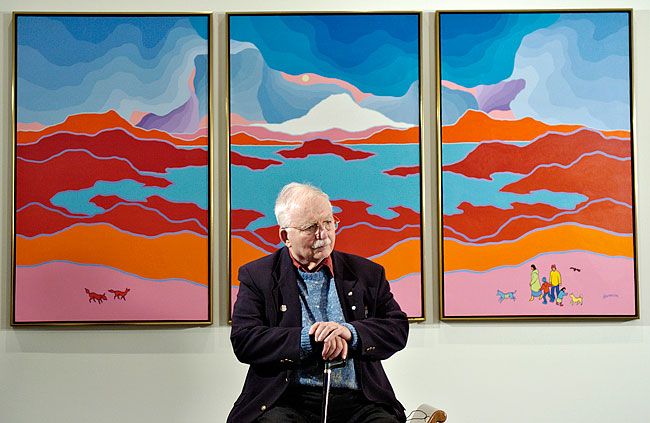
I wanted to do a Stained Glass of a Ted Harrison painting - my mundane glass skills were not up to it. But, even if they were, to take a Ted Harrison and copy it? What is the artistic skill in that? I am not creating but merely recreating. A master forger versus a master artist - who do I give higher credit to?  I would be making a bad copy.  Mr Harrison on the other hand talks about how he looks at another's art and learns things he adds to his own to create something even more unique.

The cook who can follow a recipe, or the one who can make a variation on a recipe or the one who creates the recipe? Who is the greater chef?  I give credit to the last one, as the creativity is the key for me.  The skills of cooking are still important.  The chef who imagines a new recipe but can't execute it is the one who makes the food I would least like to eat.  If a someone imagines a beautiful meal but can't use a stove properly, the food and the creation will suffer.  On the other hand, the chef who learns good knife work is not less of a chef.  Following the exercises of the basics, they don't become less creative.  They gain the skills to take the creation from in their mind and their heart and place them in the real world.

A person who can cook fish, but choses to serve raw fish can claim a certain artistic license in their choice and creation.  Picasso could claim artistic license in his paintings, and e.e. cummings in his poetry.

A person who claims artistic license in serving raw fish but really has no idea how to cook fish is maybe not really answering to some deep sense of artistry but rather to the limitations of their ability.  Some abstracts I made exactly as I wanted, expressing what I wanted to.  Some abstracts I made were accidents; failed projects that I decided I could live with or decided I wasn't going to work on futher because I wanted nothing more to do with them.  Even when they were respected as art, I knew better inside.


In Aikido, we are taught a handful of types of movements:
In Front
Behind
Front to Front
Back to Back
Front to Back
Back to Front
High
Middle
Low
Linear
Circular
Triangular
Controlling
Throwing
Small
Medium
Large
Solid
Flowing
Inside the Center
Outside the Center
Leading
Blending
Entering
Each of these types of movements can be combined in any particular combination with practice.  I like to lead down, but I found doing this exclusively caused a problem with circling.  My creativity was stunted.  Circles don't just go downward, they lead out and then rise again, then lead further only to fall once more.

I was studying while working in Mental Health and Young Offenders. I had decided that I needed to know pins.  Throws are dangerous for people that don't know how to fall; especially with chairs, stairs, tables, hard floors.  My ability to throw did not keep pace with my ability to control.  I didn't practice high falls much - I wanted to be pinned and locked myself in my free practice.  I specialized - and while I got very good at one thing, my overall practice suffered.

I learned more by being led by my teachers to study types of movements I didn't spontaneously do.  I wasn't immediately in love with certain movements that I learned the most from.  I needed to revisit and reexamine material I thought I instantly understood because I worked on it less.  In coming to understand what I didn't, I realized I had gaps in my knowledge of what I thought I had already acquired.

I came to believe in a structured teaching method.  I make a plan before I teach a class, and I think about what I want to teach well in advance of my having a chance to teach.  I still don't confuse a tool or an exercise with a creation.  I became something of an art critic by learning more about art.  In the same way, as an example I see that people who don't understand Chudan (middle) techniques are more at risk for shoulder and back injuries.  The exercises to learn Chudan are important, but are they creative spontaneous Takemuso Aiki?  They aren't even techniques in any useful sense of the word.  I started to see the beginner exercises and rote memorization with no soul, and the uninformed poorly expressed creative impulses that could be so much more powerful/healthy/effective with basic training.

I remember Sensei once saying that only Yudansha were even students.  This was a statement on his curriculuum and not a dismissing of the white belts.  People who had gone through all the white belt testing were thought to have the minimum of understanding to even begin to consistently and spontaneously move correctly without thought in any situation - Aikido.

The white belt ranks were for learning the tools, the black belt ranks were there to analyze, synthesize and learn from what they had already been taught.  "White belts do it this way or this way;  Yudansha do what you will."  Sometimes Sensei would say this; sometimes he would be very clear that he didn't think we were ready to explore no matter what colour belt we wore.  But, it was always aimed at our growth and development.

The Shodan test was really about did you already have the tools to teach yourself.  There was tons of learning earlier on, but it was mostly memorization.  Until the basic skills are acquired the learning is lopsided.  You can't delve deeply into a type of movement you haven't actually studied or practiced.

Past a point, all the advanced work is the basics reimagined and spontaneously recreated.  Having tools is an important first step - but it is only a first step of a very, very long path.  Some students resist the idea of the tools because they want the final product.  The final product is the result of the tools.

Tuesday, January 29, 2013

Choking on Bitter


“Eating Bitter” is a phrase that refers to students being willing to go through whatever their teachers tell them to do.  In Japanese arts, the word “Oos” means “go beyond.”  How much pain will my teacher ask me to endure?  I will go beyond!  How much effort?  I’ll go beyond that!  There are many ways to Eat Bitter, but I was caught up in the macho ones.

I was 26, and I moved to Lake Louise.  There were only two other Aikido people there, and one (the lowest ranked) was obsessed with Aikido politics over actual training.  The school never got off the ground.  I wanted to keep training and there was a Taekwondo group.  I got excited because I was going to learn to be more flexible.  I was determined to distinguish myself in this group with my drive and ability to eat bitter, work through the pain and give more effort than any of them.  If nothing else, I was going to do this to better represent my art and my Sensei.  I was going to give a good account of Sensei.

Every class started with high kick warm-ups (completely foreign to me), then we went into aggressive partner stretches.  Sit in the butterfly position with someone standing on my knees with someone pushing on my back with all their body weight.  Sitting on the floor with my legs spread wide, with someone grabbing my belt and pulling me forward as they spread their legs against my knees while someone put their whole body weight on my back.  Classes were very painful, and went for two hours or longer.  After the aggressive stretches, we did sparring then went back to aggressive stretches after we were warmed up.  I had seen Van Damme movies where he gained super flexibility in a five minute montague by having his legs ripped apart by ropes.  I think I actually thought this was possible, or at least a good idea.

I was genuinely surprised when I found after a month of regular training that I was less flexible.  I wasn’t going as high with my kicks.  Also, everything hurt.  All.The.Time.  I wasn’t able to hike much during the beautiful summer, both from the altitude and my legs couldn’t move up the mountain side anymore.  I needed to find a flat place to walk, and the Canadian Rockies don’t have that.

I finally asked the teacher one day to show me what the stretches looked like when he did them.  He was always having to be the one to put the extra weight on us and talking us through the workout.  He declined.

In turns out, his hip now pathologically dislocated.  He had several muscles that had been torn in his hip joint, and even attempting to do certain kicks with power could leave him unable to stand for a couple of days.  Despite his rank, he had not been the teacher for the school – the teacher had been killed in an accident recently.  The man leading the class had little experience in teaching.  The Taekwondo school folded within weeks of him telling this to the class.  I decided that I would rate my next teacher in this way:  if the art was to give someone a long, healthy life then the teacher who best represented that would be an older but very healthy person.  30 year old cripples would teach me to be crippled before I was 30.  If this Taekwondo student knew how to train to be healthy, why would he chose not to be!  I started to realize how good my Sensei had really been.

I found a karate teacher in Banff who was very impressive in his abilities.  He was a paragon of health, very quick in his movements.  His training was difficult but I could see that health was a bigger focus for him.  He showed me how he could break rocks with his hands.  (I still have a piece of one of the rocks)  His advice to me to get better at my punches was to find a small tree and wrap my jacket around it, then punch it many times.  I was inspired and I did it.  I cut my hands on the tree bark through my jacket and got blood on my jacket.  My knuckles would be bruised and torn, then I would return to the kitchen where I was working unable to hold a knife and vaguely concerned I would get blood in someone’s food – but taking time off work was not an option.

I finally thought finding a balanced approach was maybe a better idea.  I started to think for myself, and I evaluated all the training advice I was given instead of blindly following it.  Along the way, I did get a couple of hernias, a torn hamstring, a badly broken left arm and bad knees and toes.  I am the 40-year-old cripple I never wanted to be.  I did Eat Bitter – and I had eaten it until I metaphorically vomited.  There was something that my healthy Aikido teachers and healthy Taiji teachers had been trying to show me that I had missed.

I had a process of reevaluation and self-evaluation that was unpleasant.  I became a worse student in some ways.  Instead of being the example to the rest of the class of a student who put out more effort and ignored more pain, I allowed myself to get more precise and slow down.  When the teacher showed something that was painful, I modified it.

The correct posture for power is actually not excessive.  In Yoga, we study excessive postures to make the everyday posture more relaxed and comfortable.  In martial arts like Aikido, the posture we should use is not excessive, but rather a very relaxed and neutral platform for possibilities to build on.  It felt uncomfortable at first, probably because it had become unnatural for me.  In time, it became the posture that I tried to live in. 

There were more insights gained from this.  Past a point, the posture should stop being painful.  Pain is a warning signal from your body.  I started to learn this martial art as a way of life hoping to have a longer, healthier lifestyle.  If I chased the pain, I would get injured.  A small injury can be laughed off, but eventually small injuries became chronic injuries or permanent ones.  Chasing the Pain is not Eating Bitter!

From there, the problem became chasing the Effort.  A blend and neutralization is supposed to feel like nothing happened, to both the Uke and the Nage.  I learned I didn’t strive for feeling nothing if I had it in my head that this is supposed to feel difficult:  I started chasing the effort instead of the soft, relaxed power.  Soft and relaxed started to feel wrong, so I “corrected” away from this by making things feel more hard and difficult.  Often, this meant “correcting” to a more excessive posture.

I learned falls are supposed to protect your body, and as your muscles adapt and your structure improves the fall should become easy to do.  If you want to chase the pain and effort, you “correct” yourself into doing harsher falls.  I learned not to get frustrated if a roll didn’t rattle my teeth.  I stopped telling myself on the ground I felt good, therefore I was being lazy.  I learned to stop saying to myself, “Damn, I came here to get a workout and this is too easy!  Gotta ramp things up!”  I had to learn that things were not supposed to feel painful and full of effort - which meant that I never corrected something that felt painful and full of effort.  I corrected easy to be more painful, more difficult.

I learned Uke does not take proper ukemi if they think they are supposed to make this hard for Nage – they resist in a strange way that might get them hurt and in a fashion that they never could if training at full speed with a committed attack.  Resistance makes something else very easy and creates an opening that Uke does not recognize because they are trying to make this “hard.”

This resisting ukemi also only works when Nage is working in a kata – when the kata is relaxed and Nage can do freestyle, Uke has not learned to follow but only resist.  If Nage moves well, Uke is in grave danger.  For example, Uke is pressing down, hoping to make it hard for me to go up.  The movement then becomes slower for Uke, and their brain can process the fall.  What if they push down, expecting me to push up, but instead I accelerate them at the ground?  Now Uke is surprised, probably stiffens up further before impact and has no time to process what is about to happen.  They never created a learned reflex to follow the movement, because they never learned to follow when they had the chance to learn.  Uke’s technique gets insidiously worse until they get injured someday.  Uke can make a kata impossible, but the goal isn’t the kata.  The kata is there to teach the reflexes that should always be present.

If Nage plays this game, they feel for the resistance, and apply force against Uke’s strength.  Using the above example, Uke presses down and my reflex becomes to try to lift up directly against them.  Force on force.  This is me, chasing the effort, instead of learning to do the technique with the minimum of force.  My technique gets worse.  I need to be where Uke is not, and feel for their openings.  In Chasing the Effort, I am constantly bashing into a brick wall.  Maybe I could walk through the door, but smashing through the wall feels like the right thing to do so I do that instead.  Chasing the Effort is not Eating Bitter.

In chasing effort and pain, my postures become inappropriately larger, putting my body at more risk and making my technique weaker.  I start to lean more, straighten my arms, hunch my shoulders, lock out the knees or bend them too much because this is what my idiot brain has decided is what “power” feels like.

I stopped trying to do my flexibility, strength and cardio training in the dojo.  Excessive flexibility is something to work on outside of class.  When the stabilizing muscles for a joint are too lax, the joint is prone to injury.  There is no reason to make excessive stretching part of a warm up or a workout, and for power there is actually a lot of reason not to.  Strength is not something to train when I am trying to not use strength.  Feeling I need to work on my strength makes me use my muscle power more.  Muscles that have gotten fatigued, stiff and tight are more prone to injury.  Cardio training is supposed to be an effort – but proper technique should not be full of effort.

I try to now keep my precise, relaxed technical training separate and apart from these other things.

I remember Sensei’s lessons now.  He would have me practice extra slow and smooth sword cuts when he saw me trying to do 1000 at full speed.  When I would run and strain, he taught me to stand relaxed.  He was unassailable, but calm and relaxed.  His structure was perfect, and his power was amazing.  He was trying to teach me these insights all along.  His senior students that could all throw with more power and train for longer than me - they knew it too.

In putting my appetite for bitter aside, I have become a more contentious student and a bit of a headache for my teachers.  But, I am now starting to realize power.  Maybe in becoming a bad student I am becoming a better one.


Wednesday, December 19, 2012

2012 9100 Gingerbread

I was crushed when the 9100 holiday committee decided (in a meeting I was not present for) that there would be no more raffle for Christmas.  I still wanted to bake anyway.  I had one coworker who wanted an assembled, undecorated house to decorate with her children, and another coworker who had requested one for her two kids last year when I was finished decorating.  A third coworker's marriage recently ended and a messy custody battle is starting and I had left over dough with her kids in mind.


I hadn't done much with my baked on sugar cookie last year, so this year, the shingles, the candy canes, all the miniture trees - I cut and baked them all on the gingerbread pieces before assembly.


An example of the house wall.

And then the second project, which went together quickly and had a lot of inspiration going for it


I have done these in the past with a stack of oreo cookies.  I bought some, and the oreos fell apart.  They used to take some skill to open, but they've made them much easier - it was harder to keep them together than to open them.  So, I took leftover dough and made a stack of cookies of my own.


I made little sugar cookie anchors for the candy canes.


And taking inspiration from some "Pinata Cookie" idea I saw online (these are so amazingly impressive):

http://www.sheknows.com/food-and-recipes/articles/958083/cinco-de-mayo-pinata-cookies

I did something much, much simpler.  The reindeer on top is three separate cookies with the tails cut off except for the middle, and the legs and antlers cut off the middle cookie. 


Best piece of news yet, the Recreation Therapy Department has asked if I would bake for them if the Holiday Committee doesn't want a house.  So, I'm back and making money for the comfort of my patients during the holidays next year! 

Thanks everyone for your support and interest.  I know I was a little brief this time, but if you have any questions about the techniques, icing, dough, whatever, I am happy to answer those questions.  The box kits are getting bigger and fancier every year, but I know you can do this too.


Friday, December 14, 2012

Aiki-Ninjabread Cookies

I can't be the only one out there who got these cookie cutters this year.  I got two sets - one from an old girlfriend and one from Mom.  "John, I saw these and I just thought of you!" 

I'm not a ninja.  I've done Aikido since 1990, Taiji (Yang style since 1990, Chen since 2000, and Wu Hao since 2005), and I have orange belts in Shotokan Karate and Judo that predate my ever moving to the USA.  I started Nine Dragon Baguazhang in 2005, and now I am a certified teacher.  But no Ninjitsu.

Using my sugar cookie on sugar cookie technique, this:

Became this:


So, a perfect gift afterall.  Even if I'm not a ninja.


Meditation on the Heaven Gua


Heaven Palm was my first palm that I studied.  I had the most difficulty with it.  Of course, I was still trying to learn the idea of a palm at the same time as learning what it meant to be Heaven.

Heaven is the Father Palm, the pure Yang gua.  That had a number of negative connotations for me, but mostly because I didn’t understand what Heaven was.  Would Heaven even be appropriate in a hospital setting?

Heaven is a used frequently in a Judeo-Christian sense, but this is not Heaven Palm. 

The one translation is Sky Palm, but the cold, unobtainable and ultimately intangible and colourless sky did not give me a helpful image to work with. 

The linear, domineering tactical attitude of Heaven is also something I hadn’t really been drawn to Baguazhang for.  I wanted to spiral and twist and dodge and be as hard to grab as smoke.

There is no animal or image from nature to look at and call, “Heaven.”  I spent hours looking at bonfires and candles when I studied Fire.  I can remember Kingsmere Lake during a hurricane, and many summers on the Churchill River for Lake Palm.  I can’t do something similar to point the way to Heaven.

Pure Yang.  This means the Male attitude.  Women can be Heaven, but does this mean that they have to act male?  I remember a friend finishing his PhD in Engineering, getting a keg and drinking most of it himself.  He drank until he vomited, then in a blind stupor used his wife’s toothbrush to get rid of the vomit taste in his mouth.  I remember his wife so clearly pissed at him saying, “That is so…MALE!!!!”  Maybe so, but not Heaven-ly.

I have heard thugs and bullies being referred to as having too much “Yang” energy.  Dogs that need to be put down for the good of society.  Not Heaven.

Little yappy dogs wrapping their legs around anything and everything and rutting on it – maybe an excess of Yang, but not Heaven.

Incoherant, brainless rage and power, like the Incredible Hulk or a Viking berserker?  Out of control mindless destruction that is a danger to everyone around – very Yang, but not Heaven either.

The guy from nearly every cop movie ever made whose role is to be loudly wrong-headed at every turn, looking like a testosterone overdosed idiot who makes life exasperating for the hero of the movie and probably provides most of the comic relief or a minor disgustingly pathetic villain...Yang, but not Heaven either.

I was told that reading the iChing is not the answer to understanding the palm, but it worked for me reading up on several Fire translations.  So, here is my interpretation of a synthesis of several iChing translations on Heaven.

The one translation calls the Heaven Hexagram, “Creative Power.”  Creativity is associated with artistry, and not immediately thought of as Yang.  But, the foundation of Creativity is the belief that I can create something that deserves to be made, something that deserves to exist, that I can make something better than it currently is and maybe even better than it appears in nature.  For a health care professional, it starts with faith in one’s diagnostic skills and one’s ability to help.  It starts with, “I can improve this, I am the right person with the right skills at the right time and the right place to make this better.”

In the change lines, Creativity and power are not embraced for their own sake.  There is a time and place for Heaven.  Heaven is perceptive, and self aware.  Heaven assesses the situation with constant unrelenting Honesty to myself and others at all times.  Heaven sees the need to be proactive, and sometimes the need to stay still.  Heaven clearly sees the cost of acting or not acting, and is very mindful.  Heaven, even when it does nothing, even when it waits, its being firm and decisive.

Dominance is not embraced just for the sake of dominance.  If I came across someone whose heart had stopped, I would answer to the Cardiologist but take over from the family member who hasn’t learned CPR, and still be expressing Heaven.  Heaven accepts that the best course of action might be combining efforts or implementing the ideas of others, or it might demand that one leads.  Heaven has a vision, and a goal and a diamond hard focused intent.  Heaven has wisdom, perception and intelligence with its decisiveness, drive and inspiration. 

The final change line explains Heaven the best to me.  Heaven is not about me.  Heaven is about having a balanced and well defined character, a moral fiber that doesn’t change with the tides of fortune.  Heaven wants to have a visible beneficial outcome in the world.  Heaven wants your life to be prominent and valuable to everyone around you and the entire world. 

Tuesday, September 11, 2012

Alternative Health Practices in Cancer Treatment


I had someone a few years ago ask for an online martial arts group to provide information on “Alternative Health Practices.”  He had a friend who had breast cancer, and he was trying to help her.  She was resisting his attempts to help, "she was too proud," and it sounded like she did not share his belief system.
While I do note that I am an oncology nurse in this blog, I have never actually written about anything related to cancer treatment or my professional life.  This is an issue I still feel strongly about, and I wanted to submit this letter with a few modifications to the larger world.  For those people who identify themselves as Alternative Practitioners, I prefer to use the term Complimentary Therapies - I don't see myself as an "alternative" to you, and I am happy to work with you.  I have used Taiji for years to recover from a number of injuries.  I do practice meditation regularly.  I'm actually not a non-believer.  What I believe just isn't the point.
***********
There have been many sad and serious situations that I have had to live and work through because well-meaning people tried to have a loved one do or believe something that they simply could not. 

When the body has rebelled in the form of cancer and a woman has to see her feminine identity as the thing that will kill her, she is threatened by everything around her and within her.  She is dying because of herself, literally.  She's already afraid, and already under attack.  

Pride is what passes for inner strength.  I love a sassy patient. I love the ones who talk back.  The ones who are the most compliant are the ones who are dead inside already. They are the easiest ones to do something to, but they are the hardest to help.  Rejoice in her pride.  Guide her passion and pride and feel grateful for it.  You will only lose if you engage in a fight with the last piece of her still standing strong.  Either you'll break on it and lose a friend, or you will break the last piece of her still standing up and choosing to live.

As a nurse I have had families insist on praying over bags of chemotherapy, which I am happy to let happen but once a family insisted on this when a drug was going to expire and be useless within an hour.  I needed to make a choice, and I had them pray as the bag was hanging.  I recognize they had bought into something that mattered to them, and I believe it made a difference.

I have alternative practitioners who insist that the patient lie to their health professional because "we won't understand or we will judge them harshly.”  After 22 years in internal arts and practices, I am better experienced and more versed than some local alternative practitioners who question me because I am "western medicine.”  Most oncology pharmacists are well versed in the available treatments out there, and yes, many of those treatments DO affect what we are trying to do.  Even vitamins can adversely affect some chemotherapies. It is always best for the patient to be honest with us and all other practitioners, and always a problem if they are encouraged to see us as the people they cannot be honest with.

Years ago a desperate woman bought herbal remedies to help with her colon cancer.  She had not explained she was on chemo, as the herbalist said it was all poison, and she never discussed what she was doing with her oncologist (she thought her doctor would laugh at her). Both her chemo and her herbal remedy each gave her diarrhea, and with the nausea from her chemo (the antiemetic pills were "western medicine") she was admitted nearly dead from dehydration and she broke her hip slipping on her own feces while struggling to the bathroom. I had to admit her in this sorry state.  She couldn’t tell me what she'd done, and the relative who had acquired the herbs for her wouldn’t.  It took days to find out what had happened to her, and her family was terrified.  We were ready to stop treatment thinking she could not tolerate her chemotherapy and our best efforts were too lethal.  Her family thought the cancer was out of control and ravaging her body to make her so sick.  If all her practitioners had been fully informed, I don't believe she would have been on both these diarrhea causing agents simultaneously.

Telling someone that they have to buy into a treatment to make it work means the patient gets blamed when it doesn't.  It's their fault they didn't believe enough.  This is not just aimed at Chinese medicine practitioners, but a beef I have with fundamentalist Christianity as well.  "God will cure you if you pray."  So, if no cure, the patient or their loved ones never prayed enough or never believed enough or they were deemed unworthy by God.  "Maybe cancer is God's punishment," soon followed by, "Maybe God doesn't exist."  No one with cancer deserves to feel punished and abandoned by God and the people they love.

Once a woman was given seaweed puree to drink because it was supposed to help her, and there was a huge argument amongst the family when in the midst of nausea she couldn't drink the putrid smelling thick green mess.  The family fought her, then fought me when I supported her getting nutrition in a way that she could stomach. What the family missed was I was there for her, and they were against her.  The patient felt abandoned by her family's display of "love."

I recognize that love is a two edged sword. It's why the loved ones all rally around the patient and love drives the desperation to find a cure. When a wife is trying to force food down her dying husband's throat and starts to cry out, "If you really loved me you would eat this" I recognize that this comes from love. But what a sad last memory for the husband whose throat no longer works and whose digestive system has shut down. He cannot love his wife enough to override reality, and he is punished for this with his dying breath. 

If she's afraid and resisting what you want her to do, be there for her.  It's hard.  You can't force her to believe something she doesn't.  You can't help by being one more attacker in the midst of a whole universe against her.  Support her and help with her and keep your options of the things you would like to offer her open.  They'll be open eventually if you are a friend; those options will close if you try to force yourself on her.  Just be a friend.  

People make their own choices.  It can turn my stomach to see the choices people make sometimes and it can break my heart, but I can only work with them.  I can't act against their will without losing their trust and destroying the most important part of being a caregiver - the therapeutic relationship.


I wrote the original letter in Yahoo, then added material in Word, then posted it here.  The formatting is not what I wanted it to be, so please excuse it.